Resources / Checkers
Martyn's Law checker: standard or enhanced tier?
Martyn's Law, the Terrorism (Protection of Premises) Act 2025, applies to public-facing premises such as shops, venues, hotels, stations and schools where 200 or more people can be expected at the same time and to ticketed or entry-checked events of 800 or more. Answer three questions to see whether your premises or event is in scope, which tier applies and which duties follow. The duties are not in force yet: the SIA expects them to start in spring 2027.
Result
–
Duties for this result
How the checker decided
Is Martyn's Law in force? Status on 23 November 2026
No. The Act received Royal Assent on 3 April 2025, but the duties in sections 5 to 10 (notification, procedures, measures, compliance document, senior individual) and the SIA's enforcement powers have not been commenced. The Home Office says the implementation period will be at least 24 months from Royal Assent. The SIA expects the Act to come into force in spring 2027 and has said it will confirm the exact date beforehand. legislation.gov.uk lists no commencement regulations for the duties yet, so any specific day in 2027 you read elsewhere is a forecast.
- 3 April 2025
- Royal Assent; powers to make regulations in force
- 10 April 2026
- section 27 in force (SI 2026/320); Home Office statutory guidance laid on 15 April 2026, correction slip 6 August 2026
- 15 June 2026
- SIA duty to prepare guidance (s. 12(2)(a), (b), (3)) and its revenue statement (s. 18(5) to (7)) in force (SI 2026/622)
- 9 July 2026
- Notification Requirements Regulations made (SI 2026/793); they start when section 9(1) comes fully into force
- 15 October 2026
- Principal Use of Premises Regulations in force (SI 2026/1005): how to pick the principal use of mixed-use premises
- 9 November 2026
- SIA publishes a standard tier planning tool and an enhanced tier template; feedback open until 23 December 2026
- Spring 2027
- expected start of the duties, according to the SIA; volunteers test the online notification portal from early 2027
Once section 9 is in force, the clock starts on commencement day. Responsible persons for qualifying premises must notify the SIA within three months of that day, or within 28 days of becoming responsible if that is later. A qualifying event must be notified within 14 days of commencement day or of the day it is first publicised. Changes to notified details are due within 28 days for premises and 14 days for events.
Standard tier or enhanced tier: how the thresholds work
Premises are in the standard tier if 200 to 799 people can reasonably be expected at the same time, from time to time, and in the enhanced tier from 800. The premises must also include a building and be wholly or mainly used for one of the 17 uses in Schedule 1. Events have one threshold only: 800 people, and only with entry checks.
The figure is not the fire safety capacity and not an average. It is the greatest number you can reasonably expect at the busiest times, and it includes everyone working there: employees, contractors, volunteers and security staff. The guidance gives the example of a shop that usually has far fewer than 200 people inside but passes 200 every Black Friday and January sale: it is in the standard tier. A one-off surge you could not have expected, such as a product going viral overnight, does not move premises up a tier, and neither does a single one-off event: that may be a qualifying event in its own right. Recurring peaks do, even once a year. A nightclub that passes 800 on five or six special nights a year is enhanced tier premises, and so is a sports ground that hosts about ten large events a year on top of its 400-person weekly fixtures.
Places of worship, nurseries and other childcare, primary and secondary schools and further education colleges stay in the standard tier however many people attend, and events held there cannot be qualifying events. A concert for 1,000 people in a synagogue or a festival on a school playing field therefore stays a standard tier matter for the governing body. Universities are not on that list and can be in the enhanced tier.
For events, all of these must apply: the public can attend, entry is checked (paid, ticket or pass, or club membership), 800 or more people are expected at the same time at some point, and the site is not enhanced tier premises, a place of worship, a school, childcare or further education premises, or an excluded site. A run with a paid entry fee but free access for spectators is not a qualifying event, and neither is a light show with timed entry that keeps the crowd under 800. A one-off ticketed fundraiser for 800 in a village hall is a qualifying event, and the hirer who controls the hall for the night is the responsible person.
Martyn's Law duties by tier
Standard tier premises have two duties: tell the SIA, and have appropriate procedures in place so far as is reasonably practicable. Enhanced tier premises and qualifying events add protective measures, a written compliance document sent to the SIA and, for organisations, a designated senior individual.
| Duty | Standard tier | Enhanced tier and qualifying events | Act |
|---|---|---|---|
| Notify the SIA when you become or stop being responsible, and when details change | Yes | Yes, plus senior individual details and event dates | s. 9 |
| Public protection procedures: evacuation, invacuation, lockdown, communication | Yes | Yes | s. 5 |
| Public protection measures: monitoring, movement, physical safety and security, security of information | No | Assess, keep under review and put in place so far as reasonably practicable | s. 6 |
| Compliance document sent to the SIA | No | Yes; each revision within 30 days | s. 7 |
| Designate a senior individual | No | Yes, if the responsible person is an organisation | s. 10 |
| Co-ordinate with other responsible persons | Yes, where several share premises | Yes; others with control must co-operate | s. 8 |
| Maximum non-compliance penalty | £10,000 | £18 million or 5% of qualifying worldwide revenue, whichever is higher | s. 18 |
"Reasonably practicable" means weighing what a procedure or measure achieves against its cost, time and difficulty, given the premises and the resources available. The Act does not require premises to alter the building or buy equipment for their procedures, although in some cases doing so will be reasonably practicable. The Home Office's own standard tier example is a shop that uses its front door lock for lockdown, its back store room for invacuation and a one-page summary for staff. For the enhanced tier, the measures can be people (trained staff spotting suspicious behaviour), processes (a bag search policy) or physical (CCTV, hostile vehicle mitigation), and measures that cannot be put in place yet can be listed in the compliance document as proposed, with the reason and the interim mitigation.
The responsible person is whoever controls the premises for their Schedule 1 use, usually the occupier or operator and not the freeholder. A pub tenant in control of the pub is responsible, not the brewery that holds the licence. For an event it is whoever controls the site for the event. Responsibility cannot be passed to a security contractor; tasks can.
Free Martyn's Law checklist (PDF and Word)
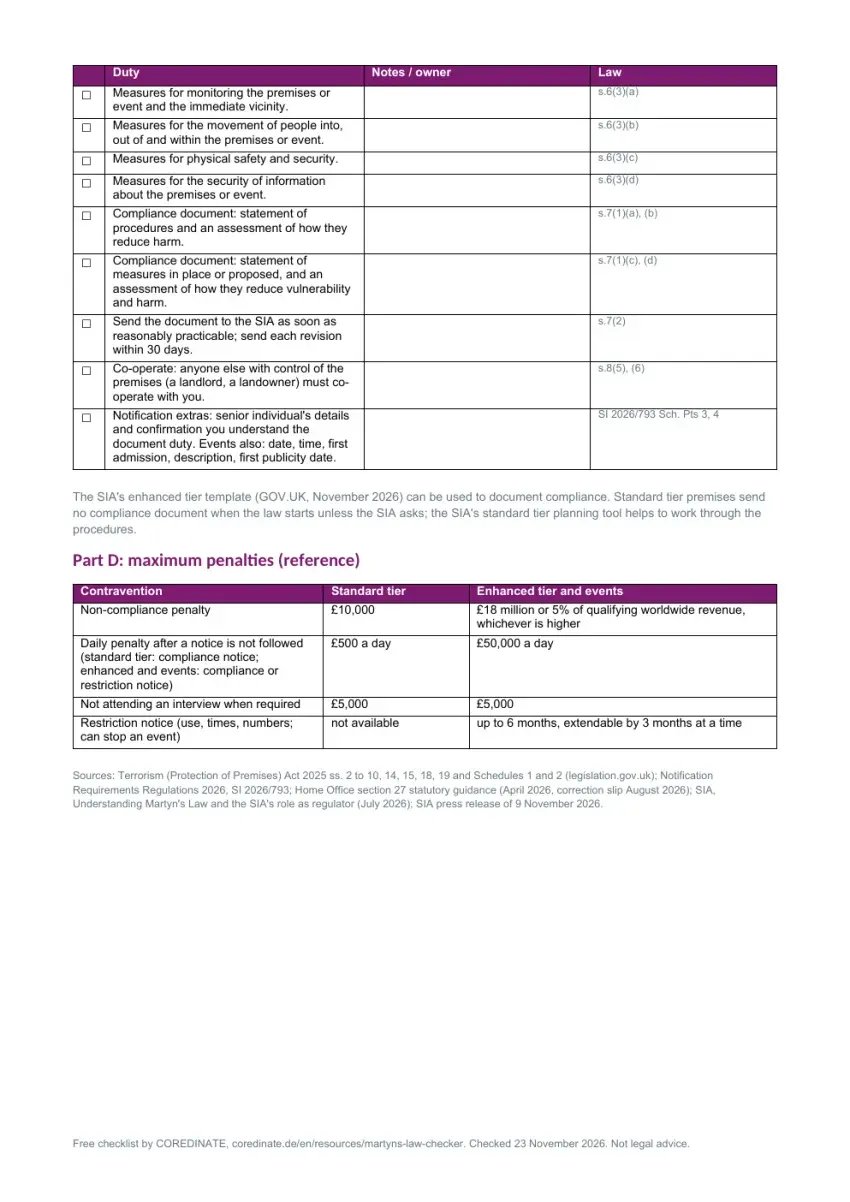
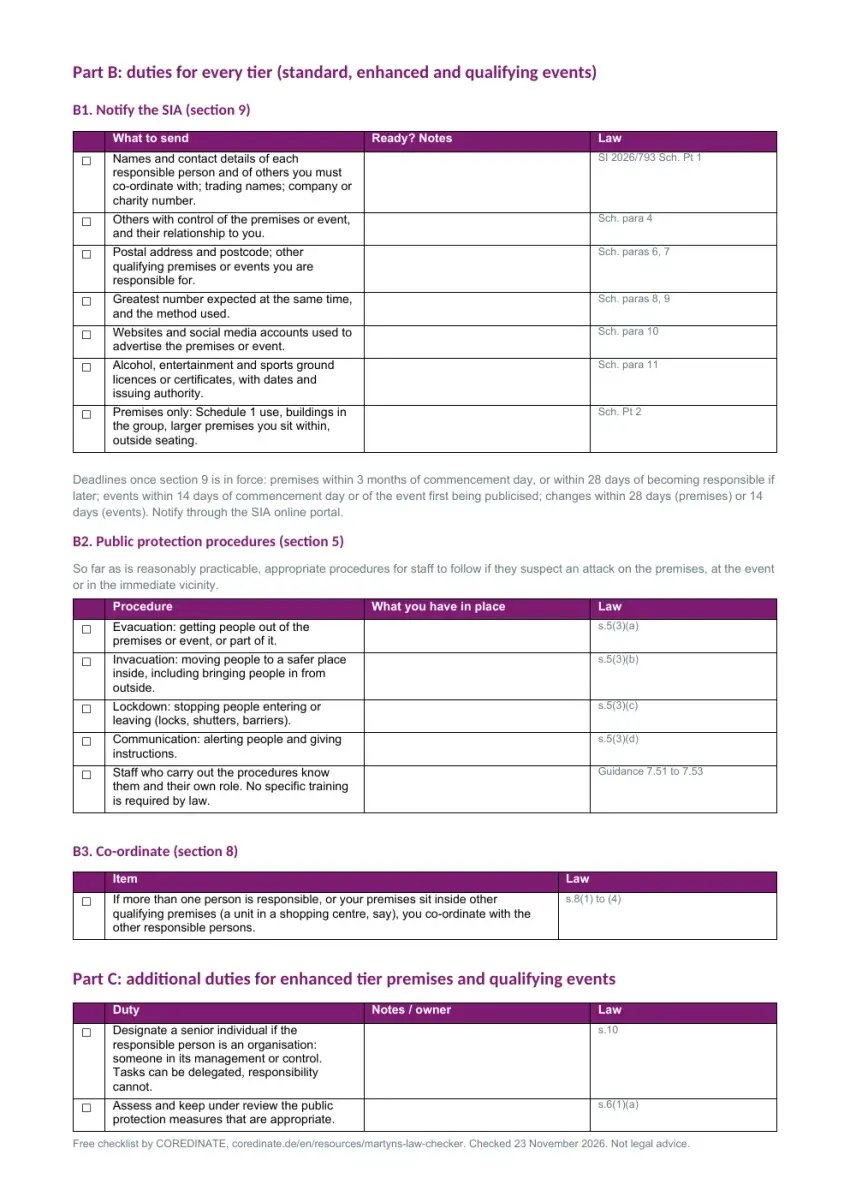
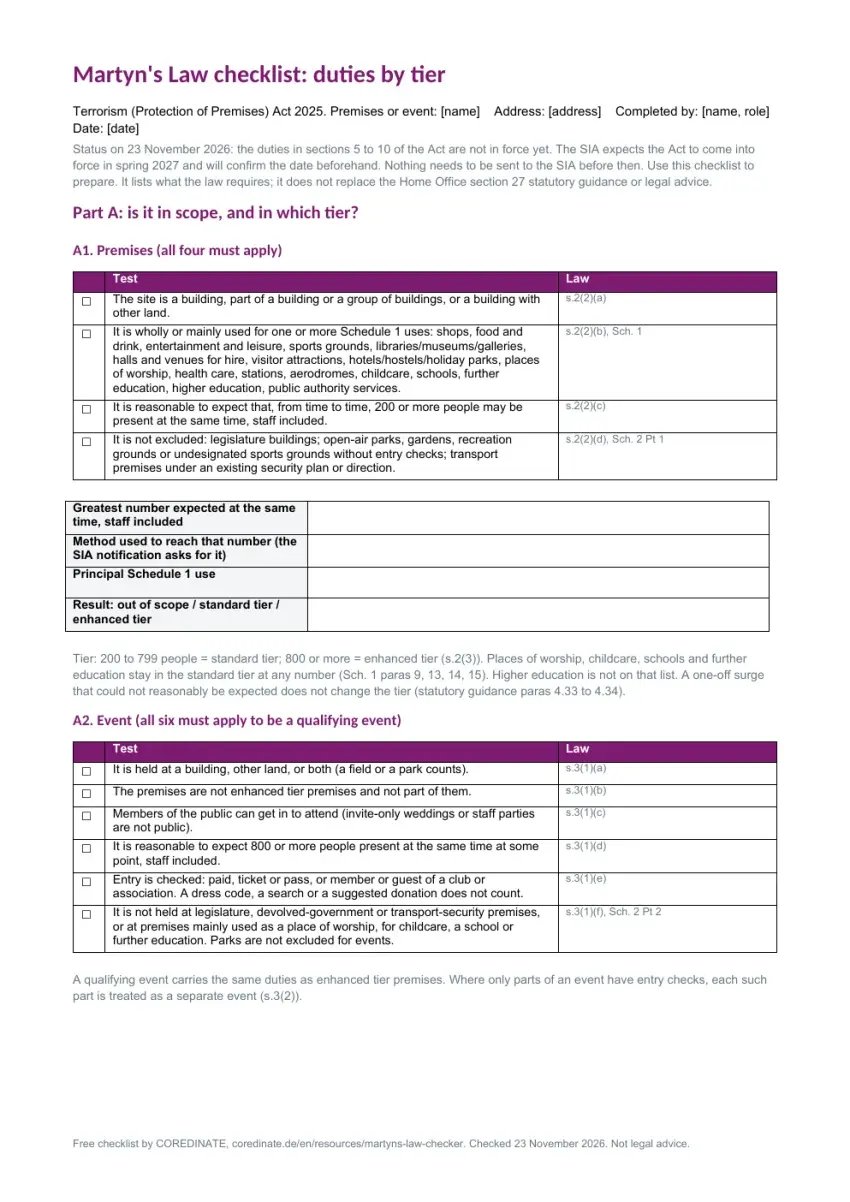
Three A4 pages: the scope tests for premises and events, every notification item the SIA will ask for, the four procedures, the four measure types, the compliance document contents and the penalty maxima, each with its section of the Act and a column for your notes. Free, no sign-up.
The checklist shows what the law requires. To write up the detail, use the SIA's own forms: the standard tier planning tool (you keep it, nothing is sent) and the enhanced tier template (sent to the SIA once the law is in force, not before).
SIA enforcement and Martyn's Law penalties
The Security Industry Authority is the regulator. It will assess compliance through desk-based checks and on-site inspections, chosen on a risk basis, and says its focus is whether those in scope have taken reasonable steps. Inspectors normally give at least 72 hours' written notice; a warrant allows entry without notice, for example where an inspection has been refused or notice would defeat its purpose. They can inspect, observe, copy documents, take photographs and require information or an interview.
The sanctions climb in steps. A compliance notice sets a deadline to fix a specific failure. For enhanced tier premises and qualifying events, a restriction notice can limit how the premises are used, when, and by how many people, or stop an event, for up to six months, extendable three months at a time. Penalty notices reach £10,000 for standard tier premises and £18 million or 5% of qualifying worldwide revenue for the enhanced tier and events. Daily penalties of up to £500 (standard) or £50,000 (enhanced) apply only on top of a penalty for ignoring a compliance or restriction notice, so the £50,000-a-day figure is not the starting fine. Compliance, restriction and penalty notices can each be appealed to the First-tier Tribunal within 28 days.
Ignoring a restriction notice, or a compliance notice for enhanced tier premises or an event, is a criminal offence with up to two years' imprisonment on indictment, as is knowingly or recklessly giving the SIA false information. Directors and managers can be prosecuted alongside their organisation if they consented to or connived in the offence, and for ignored notices also if it came about through their neglect.
Martyn's Law training: what the Act requires
The Act requires no specific training course, and the Home Office says you do not need to buy third-party training to comply. What it does require is that the people who carry out the procedures know them, know their own role and have the tools to act. A procedure nobody on shift understands is not "in place". In practice that means site-specific briefings at induction, refreshers and walk-throughs, recorded so you can show them. Enhanced tier premises should keep a record of the training and instruction staff have received as part of the compliance document. An SIA licence does not replace site-specific briefing: door supervisors and CCTV operators still need to know your procedures. Free modules are available on ProtectUK and from the NPSA.
Martyn's Law: common questions
Does Martyn's Law apply to events with fewer than 800 people?
Not as an event. A qualifying event needs 800 or more people expected at the same time, public access and entry checks. A smaller event can still fall under the Act if the venue itself is qualifying premises: then the venue's responsible person covers it under the venue's tier.
Are free community events and Christmas markets in scope?
Only if entry is checked. An open-access market, parade or fireworks display with no tickets, wristbands or membership check is not a qualifying event, whatever the crowd size. The SIA has said that many traditional Christmas markets may not meet the definition. Ticketed areas inside a free event, such as a grandstand, are assessed separately.
Does the security company become the responsible person?
No. The responsible person is whoever controls the premises or event, usually the operator or occupier. They can hire a security provider or consultant to carry out tasks, but the legal duty stays with them. A landlord or landowner who controls part of the premises must co-operate with the responsible person for enhanced tier premises and events.
Do standard tier premises have to send anything to the SIA?
Only the notification. Standard tier premises have no duty to write a compliance document or send one to the SIA, although the guidance recommends writing even simple procedures down. The SIA has said standard tier premises will not need to send compliance documents when the law starts unless asked.
Does Martyn's Law apply in Scotland and Northern Ireland?
Yes. Part 1 of the Act, with the tiers, duties and penalties, extends to England, Wales, Scotland and Northern Ireland, and the SIA regulates it UK-wide. Only the licensing plan rules in Part 2 differ by nation.
For event and security operators
What the duties mean for running events is covered in Event Security 2026: the Martyn's Law countdown, and what they cost in what Martyn's Law will actually cost event operators. Door supervisors and CCTV operators working on in-scope sites still need a front-line licence: see the SIA licence guide for employers.
Procedures that leave a record
A procedure only counts if staff carry it out. COREDINATE's guard tour app ties checks such as an exit inspection or a perimeter sweep to NFC checkpoints, records incidents with photo and time on the phone, and turns both into a report you can hand to a client or an inspector. Order a free test kit and try it on one site for 14 days.
Sources
- legislation.gov.uk: Terrorism (Protection of Premises) Act 2025, ss. 1 to 38 and Schedules 1 to 4, with commencement annotations as of 23 November 2026.
- SI 2026/320 (Commencement No. 1), SI 2026/622 (Commencement No. 2), SI 2026/793 (Notification Requirements) and SI 2026/1005 (Principal Use of Premises).
- Home Office: Terrorism (Protection of Premises) Act 2025: statutory guidance (April 2026, correction slip 6 August 2026) and supplementary documents A and B.
- Home Office: Terrorism (Protection of Premises) Act 2025: factsheets, updated 21 July 2026.
- SIA: Understanding Martyn's Law and the SIA's role as regulator (17 July 2026), New tools to support preparation for Martyn's Law and Martyn's Law: working together to prepare (both 9 November 2026).
- Home Office: Notification requirement guidance (14 July 2026).
A self-check, not legal advice. Borderline cases (mixed use, premises inside premises, events across several sites) can be put to the First-tier Tribunal under section 11 once it is in force. Checked 23 November 2026.