Twelve-hour shifts can be lawful in security guarding in Great Britain. The Working Time Regulations 1998 set no general daily maximum for adult workers, and for officers whose own work needs a permanent presence, regulation 21(b) disapplies the rules on daily rest, weekly rest, rest breaks and the length of night work. It leaves the 48-hour average week, the night worker health assessment and the duty under regulation 24 in place.
In short: Regulation 21(b) lifts the default rest and night limits from 12-hour security shifts, but only where the officer's work needs a permanent presence. The 48-hour average still applies over 26 weeks, health assessments remain, and displaced rest triggers compensatory rest, or protection where that is impossible.
This article describes the law for England, Wales and Scotland as it stands in October 2026. It is not legal advice and does not assess any individual post.
 Which Working Time Regulations rules apply to a 12-hour security shift?
The Working Time Regulations set no general daily maximum for adults, so a 12-hour shift is not ruled out by its length alone; the absolute night limit for hazardous work is the exception. For officers whose post needs a permanent presence, regulation 21(b) disapplies the night, rest and break limits, and regulation 24 applies instead.
| Rule | Default position | Officer within regulation 21(b) |
|---|---|---|
| Weekly hours (reg 4) | 48 hours average over 17 weeks, unless the worker has agreed in writing to work more | Still applies, averaged over 26 weeks |
| Night work length (reg 6(1), (2)) | Night workers average 8 hours per 24 over 17 weeks | Disapplied, subject to reg 24 |
| Hazardous night work (reg 6(7)) | No more than 8 hours in any 24 for night work with special hazards or heavy strain | Disapplied, subject to reg 24 |
| Night worker health assessment (reg 7) | Free assessment before night work and at regular intervals | Not listed in reg 21, so it still applies |
| Daily rest (reg 10) | 11 consecutive hours in each 24 | Disapplied, subject to reg 24 |
| Weekly rest (reg 11) | 24 hours in each 7 days, or two 24-hour periods or one 48-hour period in each 14 days | Disapplied, subject to reg 24 |
| Rest break (reg 12) | At least 20 uninterrupted minutes when the day is over six hours, away from the workstation | Disapplied, subject to reg 24 |
| Records (reg 9) | Adequate to show the limits are met, kept for two years | Still applies |
Regulation 22 disapplies daily and weekly rest when a shift worker changes shift and cannot take that rest between the two shifts, and a collective or workforce agreement under regulation 23 can modify the night, rest and break rules for particular groups.
Where an officer is required to work through what would otherwise be a rest period or break, regulation 24 requires the employer to allow an equivalent period of compensatory rest wherever possible. In exceptional cases where that is not possible for objective reasons, the employer must instead give the protection appropriate to safeguard the officer's health and safety.
 Regulation 21(b) of the Working Time Regulations: the permanent presence test
The special case covers "security and surveillance activities requiring a permanent presence in order to protect property and persons". The test is the individual officer's activity, not the employer's business. A contract for 24-hour cover does not by itself bring every officer on it within regulation 21(b), and if relief can be arranged, regulation 21(b) does not apply.
The Court of Appeal set this out in Hughes v The Corps of Commissionaires Management Ltd [2011] EWCA Civ 1061, about a single-manned site in Croydon covered by three guards rotating through day shift, night shift and rest day. Applying its earlier decision in Gallagher v Alpha Catering, the court held: "If working arrangements can be made so as to enable the worker to carry out his duties without his permanent presence being required throughout his shift, regulation 21(b) is not engaged."
Our reading of what that means in practice: the question is asked post by post. Where two officers share a gatehouse and one can cover the other for a break, it is hard to see why permanent presence is required. A lone officer on a single-manned site is closer to the Hughes facts, but the question of whether relief could be arranged still has to be answered for that post. Whether mobile patrols fall within regulation 21(b) is unresolved: neither regulation 2 nor regulation 21 defines permanent presence, and no case we have read decides it.
In-house officers usually need no SIA licence, but on our reading regulation 21(b) can reach an in-house officer on a static post as much as a licensed contract officer.
 The 48-hour week under the Working Time Regulations: 26 weeks and the opt-out
Officers within regulation 21 are still limited to an average of 48 hours a week, including overtime, unless they opt out in writing. Regulation 4(5) extends the averaging period from 17 to 26 weeks, and a collective or workforce agreement can extend it to 52 weeks for objective or technical reasons, or reasons concerning the organisation of work.
The GOV.UK page on maximum weekly hours lists "security and surveillance" among jobs where you "may have to work more than 48 hours a week on average". Regulation 21 does not disapply regulation 4, and Acas states that the 48-hour average "still applies to these workers".
A repeating 12-hour cycle shows how quickly the margin goes, assuming 12 hours of working time per shift. Four on, four off gives 48 hours every eight days, a cycle average of 42 hours a week. One extra 12-hour shift each fortnight lifts the cycle average to 48, and one extra shift in every cycle to 52.5. A real 26-week reference period does not divide into whole eight-day cycles, so the statutory figure has to be calculated from actual hours. Statutory annual leave, sick leave and the other excluded days in regulation 4(7) are not counted as zero hours: regulation 4(6) makes them up from the working days after the reference period.
GOV.UK states that combined hours across employers should not be more than 48 a week on average, so the officer on the 42-hour cycle above who works events for another company on rest days can exceed the limit across the two jobs while staying under it in each.
Where the combined or single-employer average would go above 48, regulation 4 requires the officer's prior written agreement, the opt-out, which can run for a fixed period or indefinitely. The officer can end it with seven days' written notice, or a longer period of up to three months if the agreement says so, and the employer must keep up-to-date records of everyone who has opted out. GOV.UK states that a worker cannot be dismissed or treated unfairly for refusing, and lists "a security guard on a vehicle carrying high-value goods" among workers who cannot opt out.
 Night workers on 12-hour nights
Under the default definition, an officer who works at least three hours between 11pm and 6am on the majority of their working days is a night worker. A 7pm to 7am shift covers that whole period. A written agreement can set a different night period of at least seven hours including midnight to 5am.
By default, for night workers outside the special case, regulation 6(1) limits normal hours to an average of eight in each 24 over 17 weeks, and GOV.UK states that workers cannot opt out of it. The stricter rule is regulation 6(7). Where night work is identified as involving special hazards or heavy physical or mental strain, in a collective or workforce agreement or in the employer's risk assessment, the limit is eight hours in any 24 with no averaging, so a 12-hour night on a post where that limit applies exceeds it. Officers within regulation 21(b) are outside both limits, with regulation 24 applying where rest is displaced. Separately, a collective or workforce agreement can modify or exclude these night provisions for particular groups, and what then applies depends on what the agreement says.
Regulation 21 does not list regulation 7, so on its wording every officer must be offered a free health assessment before becoming a night worker and at regular intervals after that. GOV.UK says it can be a questionnaire written with input from a health professional, and the officer does not have to accept. Where a registered medical practitioner advises that an officer's health problems are connected with night work and suitable day work is available, regulation 7(6) requires the transfer. GOV.UK says employers must keep confidential records of health assessments for two years, and of the dates assessments were offered where the worker declined.
 Compensatory rest on a single-manned post: what Hughes decided
Where regulation 21(b) applies, the officer has no right to a regulation 12 break, but regulation 24 requires an equivalent period of compensatory rest wherever possible. In Hughes, the Court of Appeal accepted that a break taken on site and on call, which the officer was permitted to restart if interrupted, was such compensatory rest.
Mr Hughes took his breaks in a kitchen area on site, on call, after leaving a message with a contact number on the reception desk. Sometimes the break was uninterrupted, but he could not know that in advance. The court agreed this was not a regulation 12 break, because a rest break is "an uninterrupted period of at least 20 minutes which the worker can use as he pleases". It was compensatory rest because it was a break from work which, so far as possible, ensured at least 20 minutes free of work.
Earlier in the same litigation the employer argued that the rest after the shift ended was the compensatory rest. The Employment Tribunal rejected that, holding that compensatory rest had to be taken during working time if possible. Our reading for rota planning: the Hughes arrangement worked because the break sat inside the shift and could start again after an interruption. Whether a similar arrangement is enough on another post depends on that post.
 Working Time Regulations, fatigue and HSE shift work guidance
The HSE states that compliance with the Working Time Regulations "alone is insufficient to manage the risks of fatigue", and that the duty to manage fatigue sits with the employer however willing an officer is to work extra hours. Shift patterns therefore also belong in the employer's risk assessment.
HSE guidance HSG256, Managing shift work, recommends limiting shifts to a maximum of 12 hours including overtime, no more than two or three consecutive 12-hour nights, and at least two nights' full sleep when an officer switches between days and nights. It prefers forward-rotating patterns. It also says eight-hour shifts are preferable where work is monotonous, demands vigilance or is isolated, and its summary table goes further, recommending that night shifts and monotonous or safety-critical work be limited to eight hours.
A planned 12-hour shift sits at the HSG256 ceiling, so any overrun goes past it: if the relief is two hours late, the officer on post works 14 hours. Following HSG256 is not compulsory, but the HSE says inspectors may refer to it as illustrating good practice. It asks employers to control overtime and shift swapping by monitoring and recording hours worked and rest periods.
 Records and enforcement under the Working Time Regulations
Regulation 9 requires records adequate to show that the 48-hour limit, the night limits and the health assessment duty have been met, kept for two years. Since 1 January 2024 the employer may keep them in whatever format it reasonably thinks fit, and need not record daily hours if it can show compliance another way.
The HSE and local authorities enforce the weekly limit, the night limits and the health assessments, and failing to comply with those requirements is a criminal offence under regulation 29. The HSE does not enforce rest breaks or rest periods; HSE guidance says those entitlements are enforced through employment tribunals. As a working checklist of our own, a guarding company would want to be able to show actual hours per officer over the reference period that applies to them, the signed opt-outs and any withdrawals, the health assessments offered and taken, and how compensatory rest is given on each regulation 21(b) post.
 Frequently asked questions
Are 12-hour shifts legal for security guards?
They can be. The Working Time Regulations 1998, which cover England, Wales and Scotland, set no general daily maximum for adult workers. The 48-hour average applies unless the officer has opted out in writing. The rest, break and night rules apply too, unless regulation 21(b) or a collective or workforce agreement modifies them.
Can a security officer refuse to sign the 48-hour opt-out?
Yes. GOV.UK states that a worker cannot be dismissed or treated unfairly for refusing to opt out. An officer who has signed can end the agreement with seven days' written notice, or up to three months if the agreement says so.
Does a security officer get a break on a 12-hour shift?
By default, a worker whose day is over six hours is entitled to a break of at least 20 uninterrupted minutes, unless a collective or workforce agreement sets different terms. Where regulation 21(b) applies, the officer is instead entitled to equivalent compensatory rest wherever possible. In Hughes, a restartable on-call break counted.
Is 11 hours' rest between shifts required?
By default, yes: regulation 10 gives 11 consecutive hours in each 24-hour period. It is disapplied for officers within regulation 21(b), and under regulation 22 when a shift worker changes shift and cannot take the rest between shifts. In both cases regulation 24 applies to the rest that is displaced.
How many 12-hour night shifts can an officer work in a row?
The Working Time Regulations express their limits in hours, rest periods and breaks, not in a count of consecutive nights. HSE guidance HSG256 recommends no more than two or three consecutive 12-hour nights, followed by rest days. Whichever statutory limits apply to the officer, given regulation 21(b) and any collective or workforce agreement, apply alongside that guidance.
 Shift records in the COREDINATE guard tour system
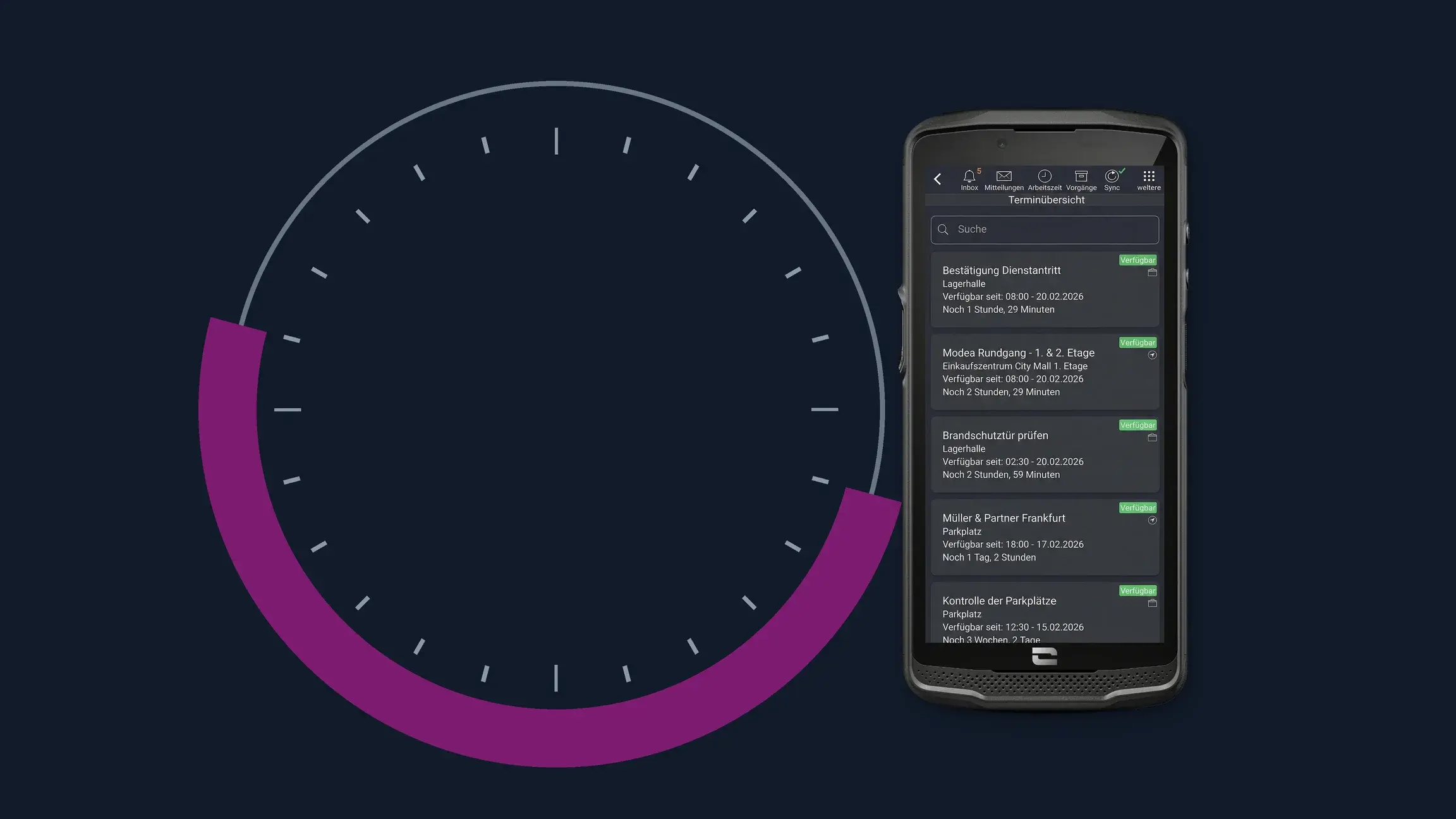
In COREDINATE, a guard tour and patrol system, the duty roster assigns officers to sites with time off, sick leave and certifications taken into account, and completed shifts transfer into working time records automatically. Time tracking starts from a checkpoint scan or manually in the app. Recorded hours export as PDF or CSV for payroll.
Try the COREDINATE guard tour and patrol system for 14 days with the test kit, free of charge and without obligation. Order the test kit