Security templates/Fire watch log/Fire watch requirements
Fire watch requirements: when a fire watch is required
A fire watch is required when a required sprinkler or fire alarm system is out of service and the fire code official orders one, during and after hot work near combustibles, and when an official orders one for an event, a construction site or a demolition. The exact rule depends on the code your state or city adopted.
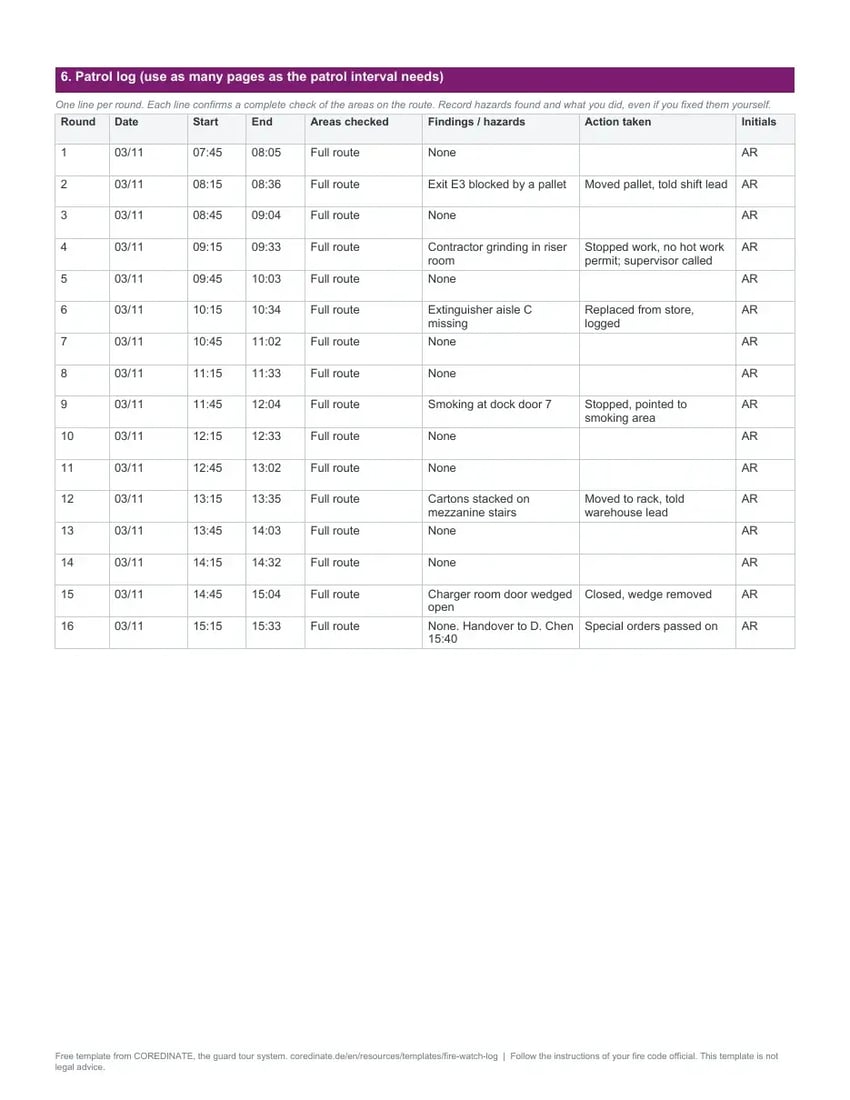
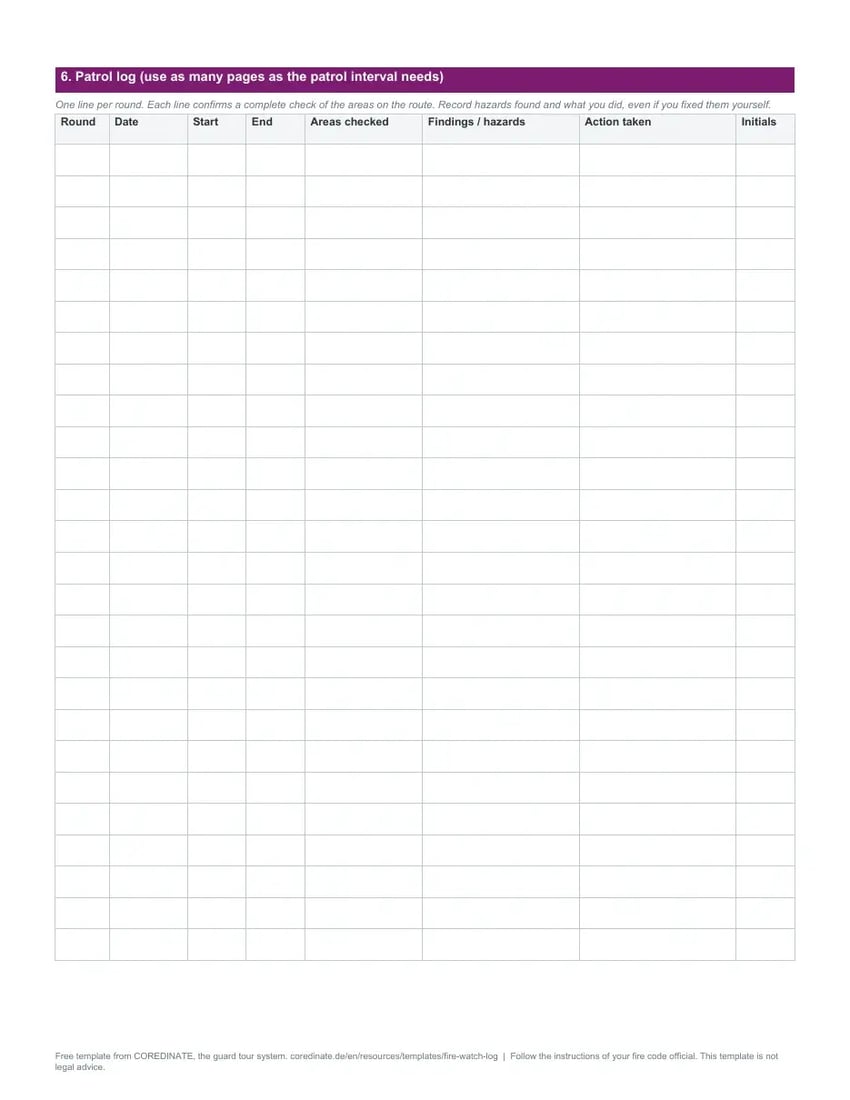
The free fire watch log template: Word and PDF, blank form plus a filled-in example. More on the log template page.
Five situations that trigger a fire watch
In each case somebody with authority decides that a fire watch replaces protection the building is missing. The fire watch is a stopgap, never a permanent arrangement.
- Fire protection system out of service
International Fire Code 901.7: when a required fire protection system is out of service, the fire department and the fire code official are notified immediately. Where the official requires it, the building is evacuated or an approved fire watch is provided for everyone left unprotected, until the system is back in service. California applies the same wording through its fire code, as HCAI CAN 9-901.7 for health facilities shows.
- Hot work
- Places of assembly
IFC 403.11.1, as quoted by the City of Gaffney: where the fire code official thinks it is essential because of the number of people or the nature of the event, the owner provides fire watch personnel. They stay on duty while the place is open to the public and watch for fires and blocked exits.
- Construction and demolition
IFC 3305.5 covers fire watches during construction and demolition. The public sources we read quote only its records rule, 3305.5.3: every period of duty, every patrol and every time a structure was entered and inspected. California's version applies the fire watch when the fire marshal requires it. Check your adopted edition for sites where it applies automatically.
- Any other order
HCAI also names a fire, unauthorized work and work without a permit as reasons for a fire watch. CAL FIRE San Luis Obispo lists an excessive number of accidental activations or nuisance alarms as a trigger.
Sprinkler and alarm impairments: the 4-hour and 10-hour rules
The often-quoted thresholds come from NFPA 101 (Life Safety Code) and NFPA 25, which are copyrighted. The federal CMS fire safety survey form for health care facilities reproduces them, so we cite that.
What the CMS form says
- K346: a required fire alarm system out of service for more than 4 hours in a 24-hour period: notify the authority having jurisdiction, then evacuate or post an approved fire watch (LSC 9.6.1.6).
- K354: when sprinklers are impaired, determine extent and duration, inspect the areas involved, tell management and the fire department. More than 10 hours in 24 hours: evacuate or fire watch (LSC 9.7.5, NFPA 25 15.5.2).
How to read it
- The CMS text counts hours "in a 24 hour period", not one continuous outage. Ask the authority whether separate outages on the same day add up.
- Under the IFC, notification is immediate whatever the duration, and the fire code official decides whether a fire watch is needed.
- Local rules can be stricter: CAL FIRE San Luis Obispo wants a fire watch after 8 hours of trouble or supervisory signals.
Hot work: OSHA's fire watch rules
For hot work, the fire watch is an employer duty under OSHA, and the supervisor must see that fire watchers are available at the site (1910.252(a)(2)(xiv)(G)). The three standards differ in detail:
| Standard | When a fire watch is required | After the work |
|---|---|---|
| 1910.252, general industry | Where more than a minor fire might develop, or: appreciable combustibles within 35 feet; combustibles further away but easily ignited by sparks; wall or floor openings within 35 feet; combustibles on the other side of metal walls or roofs | At least half an hour |
| 1915.504, shipyards | Eight listed conditions, among them combustibles within 35 feet that cannot be removed or shielded, and hot work near insulation or sandwich construction. Requires a written fire watch policy | At least 30 minutes, unless the employer surveys the area and finds no further hazard |
| 1926.352, construction | When normal fire prevention precautions are not sufficient | "A sufficient period of time" to make sure no fire is possible |
Under 1910.252 the fire watch has extinguishing equipment at hand and is trained to use it, knows how to sound the alarm, watches all exposed areas, fights a fire only when it is clearly within the capacity of the equipment and otherwise raises the alarm ((a)(2)(iii)(B)). The shipyard standard 1915.504 lists similar duties and adds the authority to stop work. NFPA 51B, the hot work standard many permits refer to, is not quoted here because we did not read it; check the time your permit states.
What the person on fire watch does, and does not do
Duties named in the codes and guidance
- Patrol the whole area at the ordered interval, rooms, basements and penthouses included
- Watch for fires, blocked exits and other hazards, and fix them where possible
- Call 911 with the exact address and say the system is impaired
- Alert occupants and start the evacuation
- Use a portable extinguisher only on a fire within its capacity
- Record every round and pass on special orders at relief
Not part of the job
- Other duties: the fire watch has one job (IFC 901.7, OSHA 1915.504)
- Firefighting beyond what an ordinary person would do (CAL FIRE San Luis Obispo)
- Leaving before being properly relieved (HCAI)
- Ending the fire watch because the contractor says the system works: the authority ends it, in writing where HCAI applies
Who sets the rules where you are
States and cities adopt either the International Fire Code or NFPA 1, in a particular edition and often with local amendments, and the fire code official interprets them. The result is that the interval and the paperwork change from one jurisdiction to the next, even when the trigger is the same.
Three examples from public guidance: California HCAI wants patrols at least once an hour in the health facilities it regulates and a copy of the log for every 24-hour period. Carroll County, Georgia sets continuous, 30-minute or 60-minute patrols by occupancy and wants the logs emailed daily. CAL FIRE San Luis Obispo wants hourly patrols, two-way radios when two or more people are on watch, and the log book kept on site.
So the first call goes to the fire marshal's office: ask which interval applies, how they want the log, and how the fire watch will be ended. Write the answers into the first section of the fire watch log so the officers on the night shift have them too.
Frequently asked questions
Does OSHA require a fire watch?
For hot work, yes. 29 CFR 1910.252 requires fire watchers when welding or cutting is done where more than a minor fire could develop, for example with combustibles closer than 35 feet. Shipyards follow 1915.504 and construction 1926.352. Fire watches for impaired sprinkler or alarm systems are a fire code matter, not an OSHA rule.
How long must a fire watch stay after hot work?
At least 30 minutes after welding or cutting ends under 1910.252. In shipyards, 1915.504 also sets 30 minutes unless the employer surveys the area and finds no further fire hazard. The construction standard asks for a sufficient period. Your hot work permit or insurer may set a longer time.
How long can a sprinkler system be out of service without a fire watch?
Under the IFC, the fire department and fire code official must be told immediately and decide. For health care buildings, the CMS fire safety survey form sets more than 10 hours in a 24-hour period for sprinklers and more than 4 hours for fire alarms.
Can the fire watch do other work at the same time?
No. IFC 901.7 says the only duty of a fire watch is to patrol and keep watch for fires, and OSHA 1915.504 forbids other duties during hot work. CAL FIRE San Luis Obispo allows other duties only where the fire department designates them.
Do I need a licensed security company for a fire watch?
Not according to CAL FIRE San Luis Obispo, which says the building owner provides the personnel and a professional security company is not required. Other fire departments may set conditions, so check the order you received.
See every fire watch round as it happens
Order a free test kit and try checkpoint scans and live tour monitoring in COREDINATE's guard tour app for 14 days.
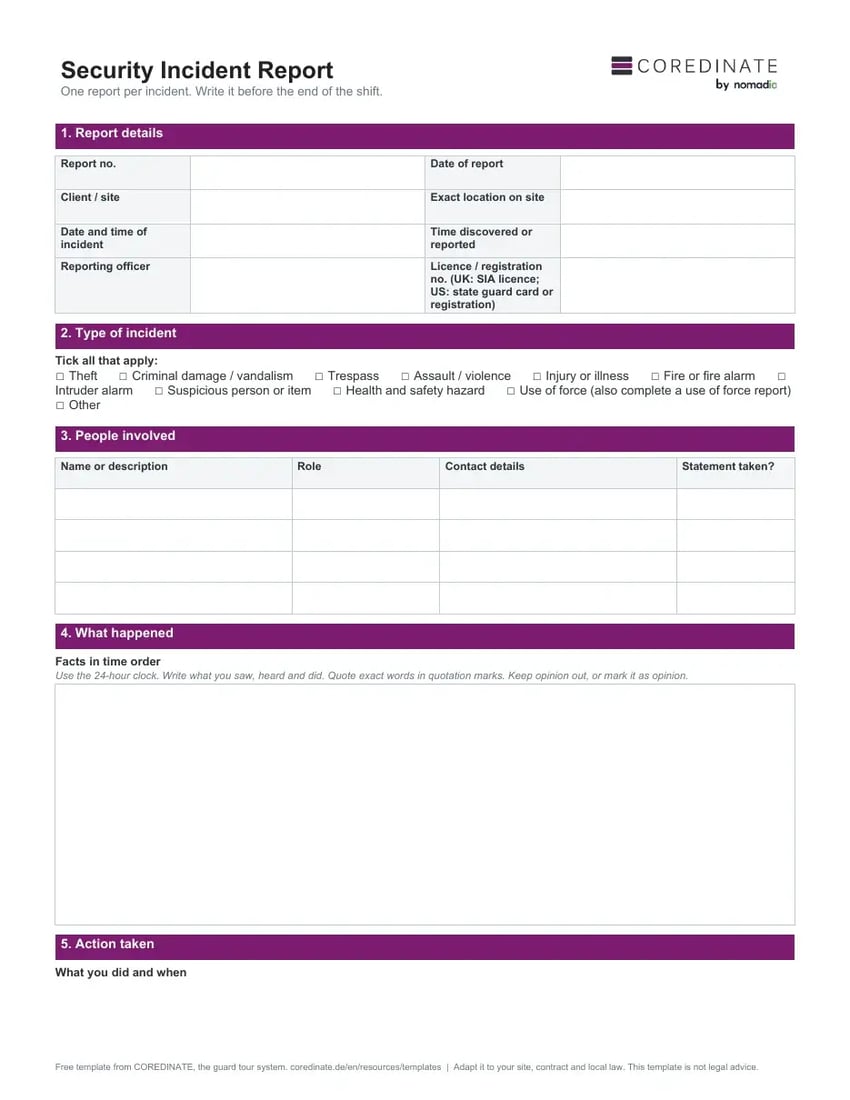
Templates for the fire watch and after
All security templates →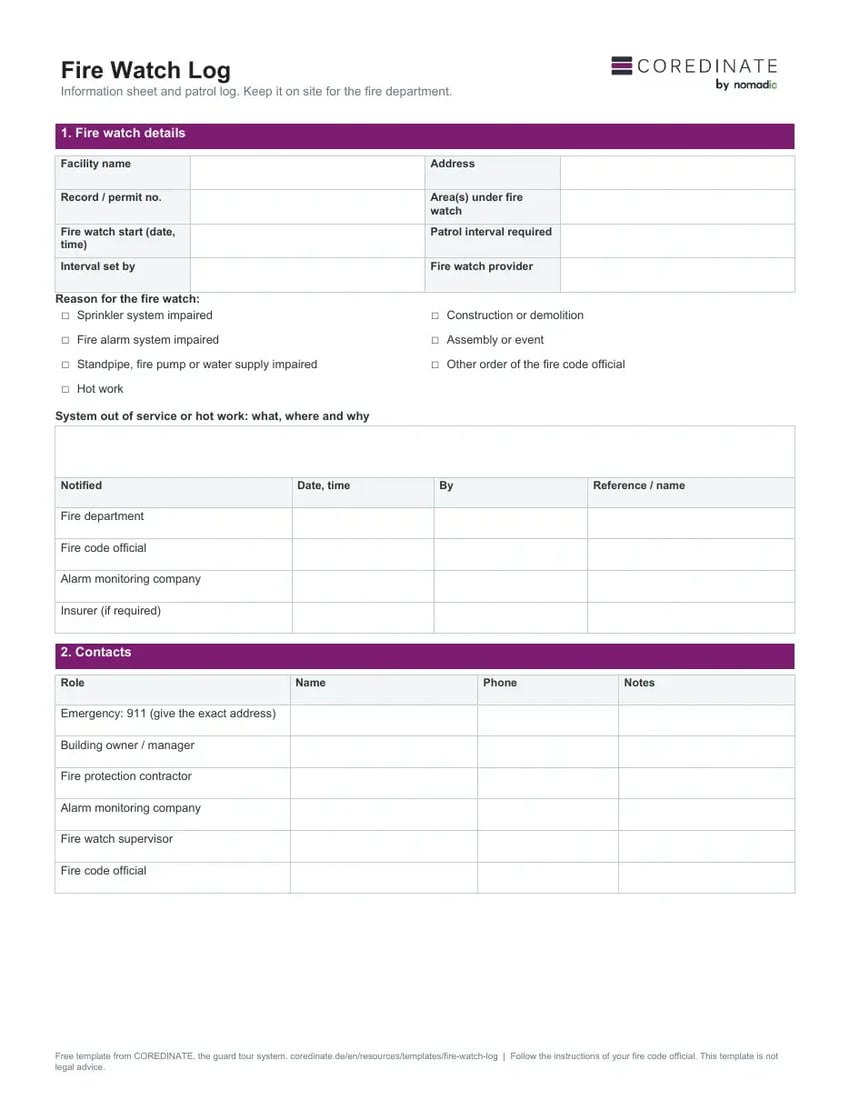
Sources
- CMS, Fire Safety Survey Report, 2012 Life Safety Code, Healthcare (Form CMS-2786R): K346, K354
- OSHA 29 CFR 1910.252, general requirements for welding, cutting and brazing
- 29 CFR 1915.504, fire watches (shipyard employment)
- OSHA 29 CFR 1926.352, fire prevention (construction)
- California HCAI, Code Application Notice CAN 9-901.7 Fire Watch (2022 California Fire Code 202, 901.7)
- City of Gaffney Fire Department: Fire Watch (2021 IFC 202, 901.7, 403.11.1, 3305.5.3)
- Carroll County Fire Rescue, Fire Marshal's Office: Fire Watch Requirements
- CAL FIRE / San Luis Obispo County Fire Department: Fire Watch
NFPA 1, 25, 51B, 72 and 101 were not read for this page; their thresholds are cited from the CMS form. Not legal advice.