Security templates/Bomb threat checklist
Bomb threat checklist for security officers
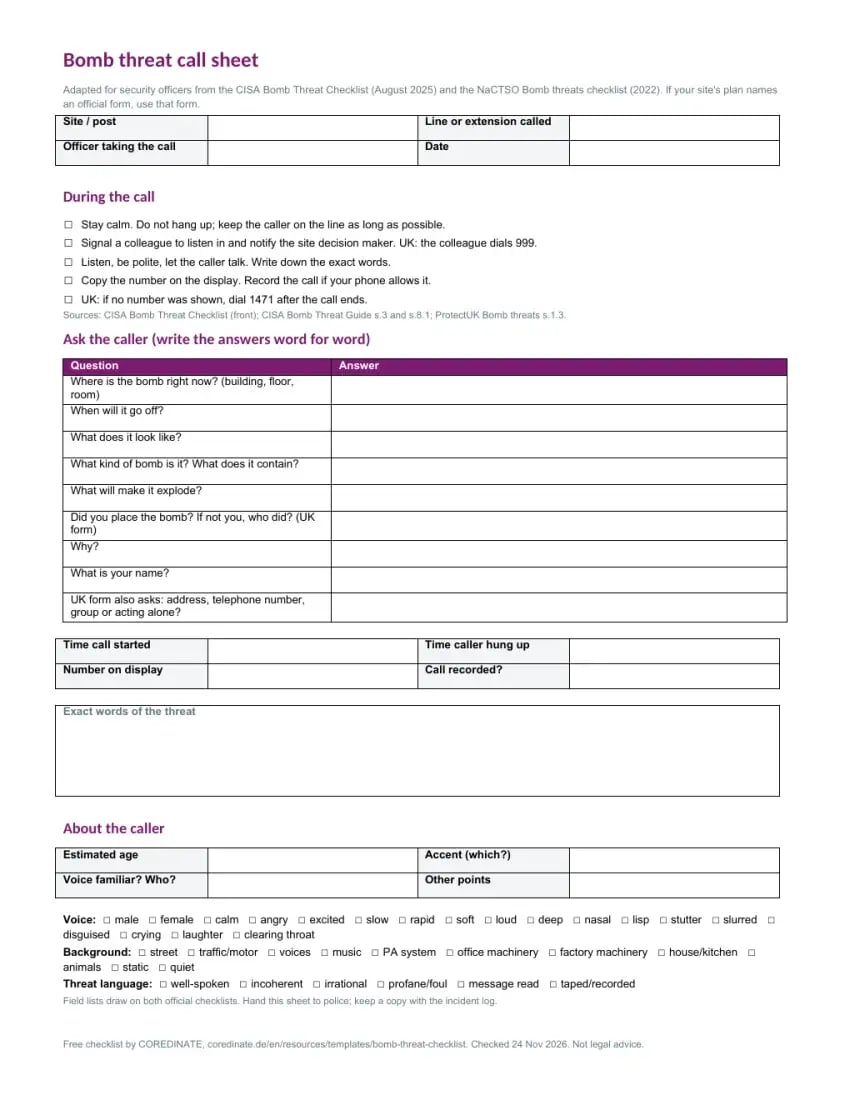
A bomb threat checklist is the form you fill in while a threat comes in: the caller's exact words, the answers to a set of questions, the voice and the background noise. CISA in the US and NaCTSO in the UK publish the official versions. Our free download adapts both for officers on a post and adds the log of what happens after the call.
Free, no sign-up. Three pages: call sheet, immediate actions, incident log. Based on CISA's Bomb Threat Checklist (August 2025) and the NaCTSO Bomb threats checklist (2022). It adapts them and does not replace them.
The official bomb threat checklists, and what ours adds
Use the official checklist your site's plan names. In the US that is CISA's Bomb Threat Checklist, in the UK the NaCTSO Bomb threats checklist published on ProtectUK. Both cover the call itself. The CISA form has no space for who was told and when, and the NaCTSO form records only the police and one manager. Neither covers what the site's decision maker ordered, which areas were searched or what was handed to police.
| US: CISA | UK: NaCTSO | |
|---|---|---|
| Version | Bomb Threat Checklist, as of August 2025 | Bomb threats checklist, Crown copyright 2022 |
| Questions for the caller | 8: location, timing, appearance, type, trigger, did you place it, why, name | 11: adds the caller's address and phone number, group or alone, and who placed it |
| Police | Report to local law enforcement; call 911 if a suspicious item is found or the threat is elevated | Dial 999 for every threat |
| Email and social media | Do not log out, leave the message open, take a screenshot | Do not reply, forward or delete; keep web logs from 7 days before to 48 hours after |
| Keep the form | No period stated | 7 years; hand a copy to police and to security or the coordinating manager |
Our checklist uses its own wording and layout. It takes the questions both forms share, marks the ones only the UK form asks, and adds an officer's log for notifications, decisions, searches and handover. Get the originals from CISA and from ProtectUK (Advice and guidance, Bomb threats). The NaCTSO form may not be reproduced, so we point to it rather than copy it.
Taking a bomb threat call
Stay calm, keep the caller talking, get a colleague to call the police and write down the exact words. CISA and ProtectUK both put these steps first.
Signal a colleague
Get someone to listen in and notify the site's decision maker. In the UK, the colleague dials 999 while you keep the caller talking.
Keep the line open
CISA: "do not hang up, keep the caller on the line for as long as possible." Listen, stay polite and let the caller talk.
Ask the questions
Where is the bomb? When will it go off? What does it look like? What kind of bomb is it? What will make it explode? Did you place it? Why? What is your name?
Write it down
The exact words, the number on the display, voice, accent and background noise. Record the call if your phone can.
After the call
In the UK, dial 1471 if no number was shown. Finish the checklist while the call is fresh and stay available for police interviews.
A threat can also arrive as a recorded or synthesized message. ProtectUK's advice is to write down as much detail as possible and keep the recording for police. Anyone who answers an outside line can receive a threat, so the call sheet belongs at the front desk, the gatehouse and the control room.
Free bomb threat checklist (PDF and Word)
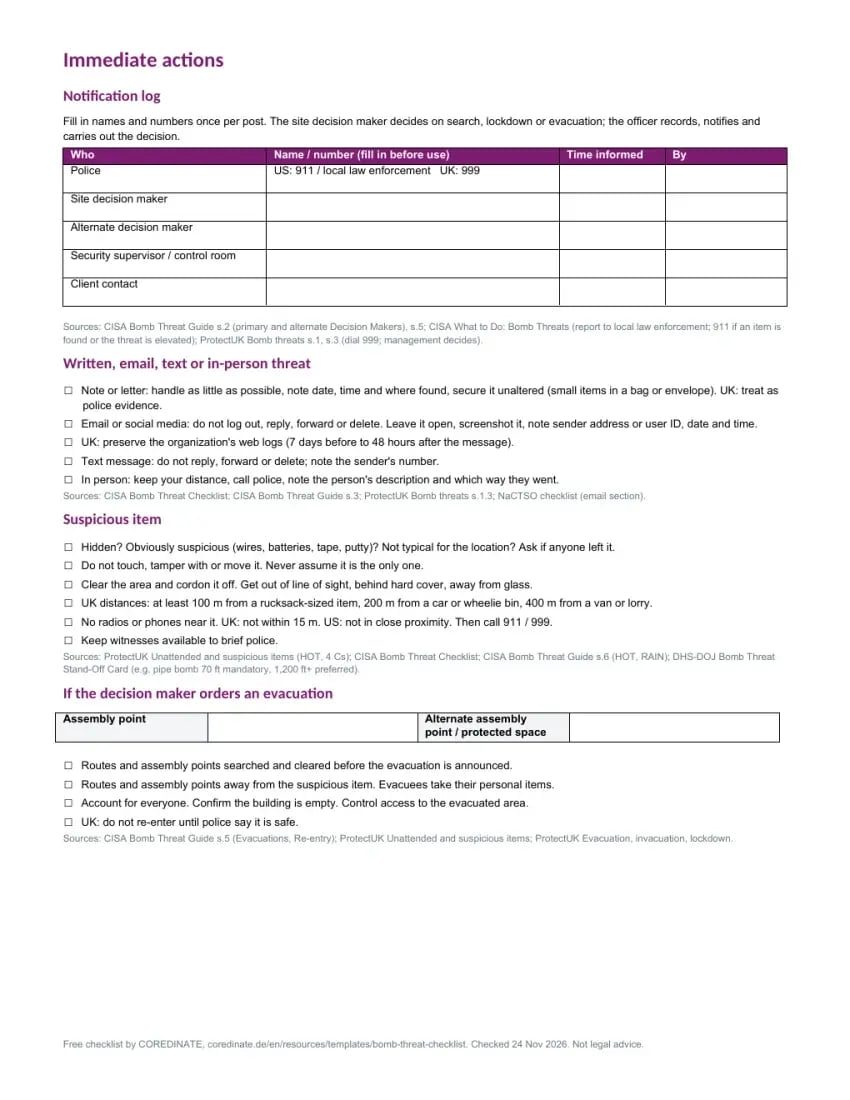
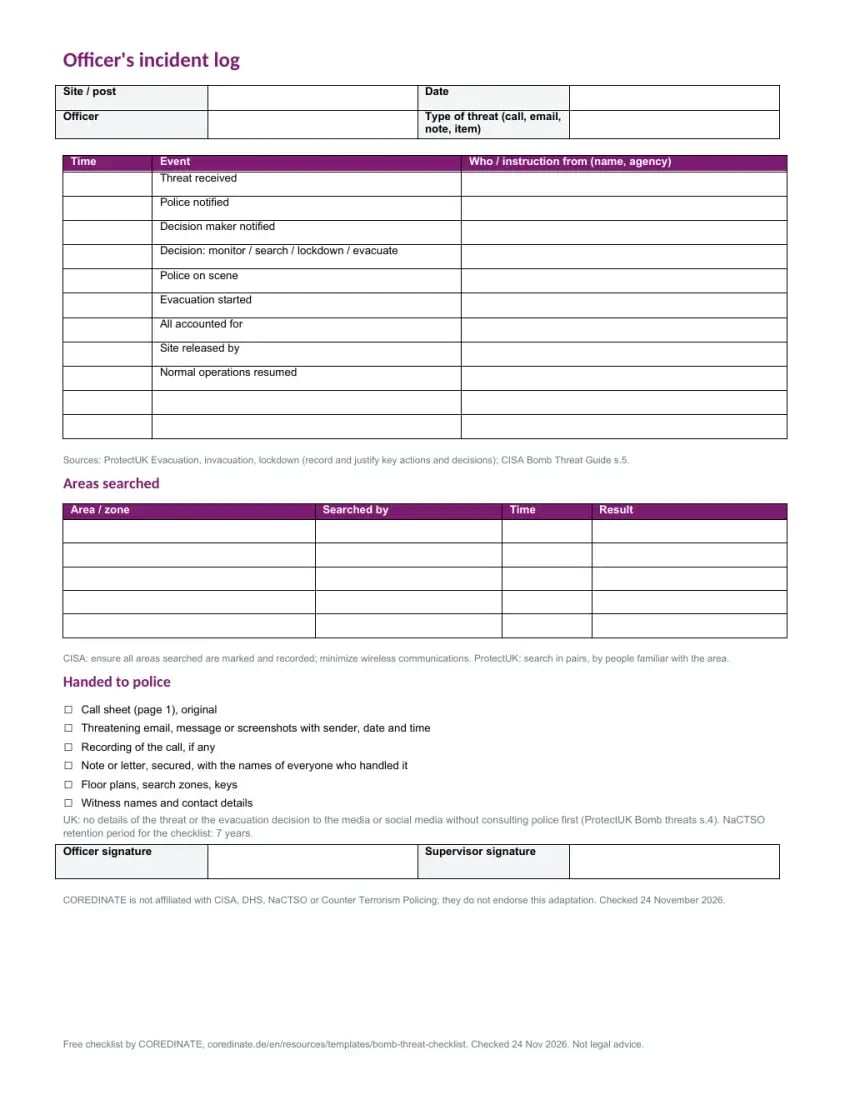
Page 1 is the call sheet. Page 2 covers written, email and in-person threats, the notification log with times, and the steps for a suspicious item with the UK and US distances. Page 3 is the officer's incident log: decisions, areas searched, evacuation and re-entry, handover to police.
Fill in the site's decision maker, their alternate and the phone numbers once per post, then print it. Every step names its source.
Written, email, social media and in-person threats
The message stays where it arrived, untouched, until police take it.
| US: CISA | UK: ProtectUK | |
|---|---|---|
| Note or letter | Handle it as little as possible. Note date, time and where it was found. Secure it without altering it; a small item goes in a bag or envelope. | Treat it as police evidence and stop other people touching it. |
| Email or social media | Do not turn off or log out. Leave the message open. Take a screenshot or copy the message and subject line. Note date and time. | Do not reply, forward or delete. Note the sender's address or user ID. Preserve the organization's web logs. |
| Text message | Not covered separately. | Do not reply, forward or delete. Note the sender's number and follow police advice. |
| In person | Keep your distance, call police, note which way the person went and describe them. | Remember distinguishing features and exactly what was said. |
On a post, the tempting reaction is to forward it: to a supervisor, the client, a group chat. The UK guidance rules that out, and CISA wants the message left open on the device it arrived on.
Who decides: evacuate, lock down or carry on
The site's decision maker decides, not the officer who took the call. CISA calls this person the Decision Maker. ProtectUK puts the initial decision with the management of the threatened location and tells them not to delay it while waiting for police to arrive.
CISA's Bomb Threat Guide (August 2025) gives the decision maker four options:
- Assess and monitor
- The threat is not credible enough to act on. Keep watching for new information.
- Assess and search
- Partial or full search without a lockdown, to gain time for the assessment.
- Assess, search and lockdown
- Search while restricting entry, partially or fully, so nothing new is brought in.
- Assess and evacuate
- The threat is credible. Evacuate after priority searches of routes and assembly areas.
Evacuation is not the automatic answer. CISA: "Even if a threat seems adequately credible, do not automatically evacuate," because hostile actors have used bomb threats to better target people. ProtectUK calls a decision not to evacuate "reasonable and proportionate" if the threat is judged implausible, and suggests not starting an evacuation with the fire alarm, to reduce the chance of the wrong response. In exceptional cases UK police may insist on evacuation, in consultation with the site's security manager.
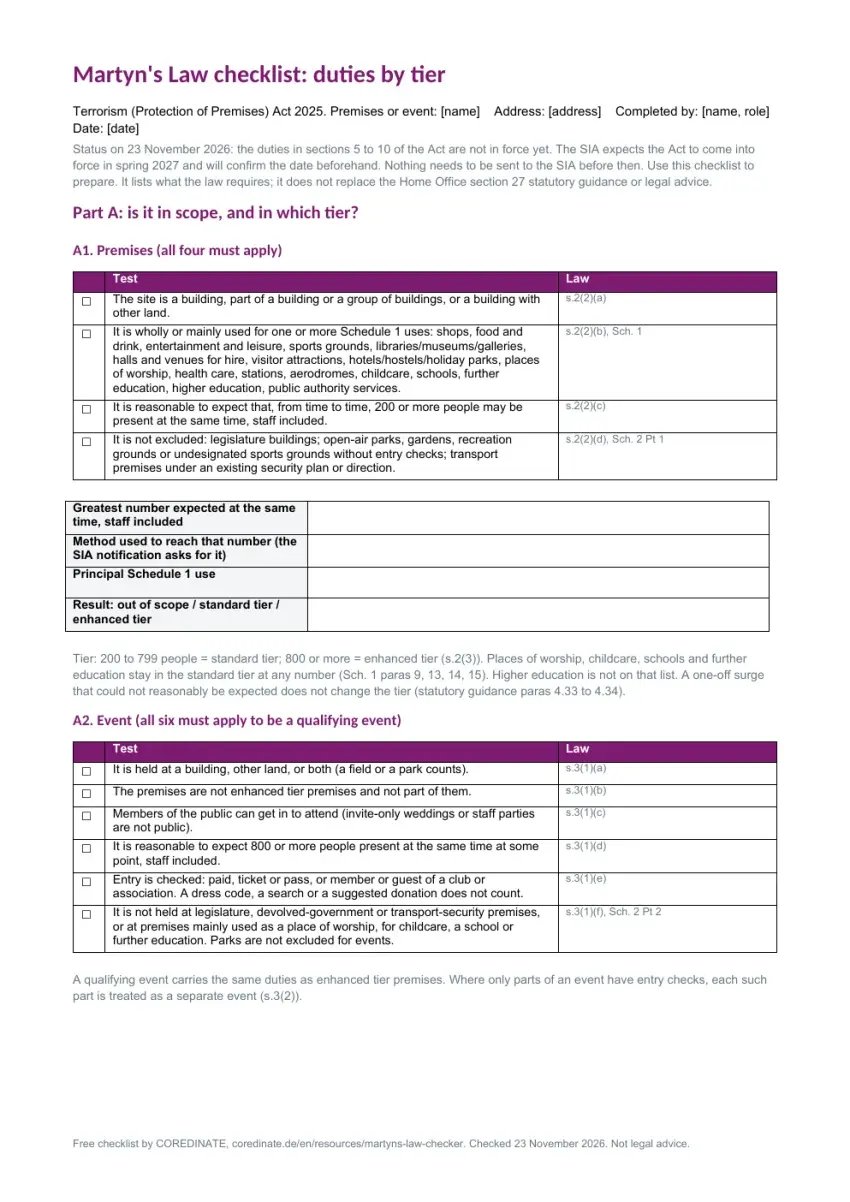
The officer's job is to record, notify and carry out the decision. That only works if the post orders name the decision maker and an alternate, as CISA recommends, with numbers that answer around the clock. In the UK, premises in scope of Martyn's Law will need procedures for evacuation, invacuation, lockdown and communication; our Martyn's Law checker shows whether a site is in scope.
Search and suspicious items
Searches are done by people who know the area, ideally in pairs, and include evacuation routes and assembly points. If an item looks suspicious, nobody touches it: clear the area, cordon it off and call police from a distance.
Searching
- Searchers need no explosives expertise. They must be familiar with the area and what they are looking for (ProtectUK, Search planning).
- Divide the site into areas one or two people can cover, including stairs, toilets, lifts, car parks and loading bays (ProtectUK).
- Search public areas, assembly locations and exterior evacuation routes before an evacuation is announced (CISA).
- Mark and record every area searched. Never assume there is only one device, and never trust the detonation time given in the threat (CISA).
- Keep wireless communication to a minimum during the search (CISA).
Unattended or suspicious?
Both countries use HOT: is the item Hidden, Obviously suspicious (wires, batteries, tape, putty-like substances) or not Typical for the location? Most lost property turns up where people gather or wait, so ask around first.
Once it is suspicious
UK staff follow the 4 Cs: Confirm, Clear, Communicate, Control. CISA uses RAIN: Recognize, Avoid, Isolate, Notify. Both include the same rule: do not touch or move the item.
| Guidance | Item | Distance |
|---|---|---|
| ProtectUK | Small item such as a rucksack | At least 100 m |
| ProtectUK | Small vehicle or large item such as a car or wheelie bin | At least 200 m |
| ProtectUK | Large vehicle such as a van or lorry | At least 400 m |
| ProtectUK | Radios and phones | Not within 15 m, out of line of sight |
| CISA stand-off card | Pipe bomb (5 lbs) | 70 ft mandatory, 1,200 ft or more preferred |
| CISA stand-off card | Briefcase or suitcase (50 lbs) | 150 ft mandatory, 1,850 ft or more preferred |
| CISA checklist | Two-way radios and cell phones | Not "in close proximity"; no figure given |
Keep witnesses on hand so they can tell police what they saw (ProtectUK), and make sure everyone who found or saw the item is available to brief first responders (CISA stand-off card).
Logging the incident and handing over
Write it up while it is fresh: the completed checklist, every notification with the time and the name of the person told, the decision maker's instructions, the areas searched and who released the site. ProtectUK's evacuation guidance says to "record and justify key actions and decisions taken", and CISA wants every searched area marked and recorded.
With COREDINATE, the officer logs the threat as an incident in the app, time-stamped in the digital guard book. Set up a notification rule for that incident type's impact level and it emails the supervisor and the client at once. A photo belongs to the threatening email on screen, never to a suspicious item: phones stay away from it.
Re-entry and afterwards
- The decision maker sets when and how people go back in. CISA suggests a phased return: security in place before operations restart, staff before the public.
- After an evacuation for a suspicious item, do not re-enter until police say it is safe (ProtectUK).
- Do not discuss the threat with the media or on social media without consulting police first. Publicity can be the hoaxer's goal and can prompt copycats (ProtectUK).
- ProtectUK also says not to disregard the possibility that a hoax was a test of the site's processes, as part of hostile reconnaissance.
For the written report, our security incident report template has the fields an investigator or client will ask for.
Bomb threat checklist: common questions
Is there an official bomb threat checklist?
Yes. In the US, CISA's Office for Bombing Prevention publishes the Bomb Threat Checklist (current version August 2025). In the UK, NaCTSO publishes the Bomb threats checklist on ProtectUK. Use the one your site's plan names; our version adapts both for security officers.
Should you hang up on a bomb threat caller?
No. CISA says to remain calm, not hang up and keep the caller on the line as long as possible. ProtectUK says to keep the caller talking if practical while a colleague dials 999, and to dial 1471 after the call if the number was not displayed.
Do you have to evacuate for every bomb threat?
No. CISA's guide says not to evacuate automatically, even for a credible threat, and lists monitoring, searching and lockdown as alternatives. ProtectUK calls a decision not to evacuate reasonable and proportionate if the threat is judged implausible. The site's decision maker decides.
Can you use a radio or phone near a suspicious item?
No. ProtectUK says not to use radios or phones within 15 metres of the item and to stay out of its line of sight. CISA's checklist says not to use two-way radios or cell phones in close proximity to a suspicious item, without giving a distance.
How long should you keep a completed bomb threat checklist?
The NaCTSO checklist states a retention period of 7 years and asks for a copy to go to police and to security or the coordinating manager. CISA's checklist states no retention period.
Incidents logged with time and photo, from the officer's phone
Order a free test kit and try COREDINATE's guard tour app with your own incident types and notification rules for 14 days.
More security templates
All security templates →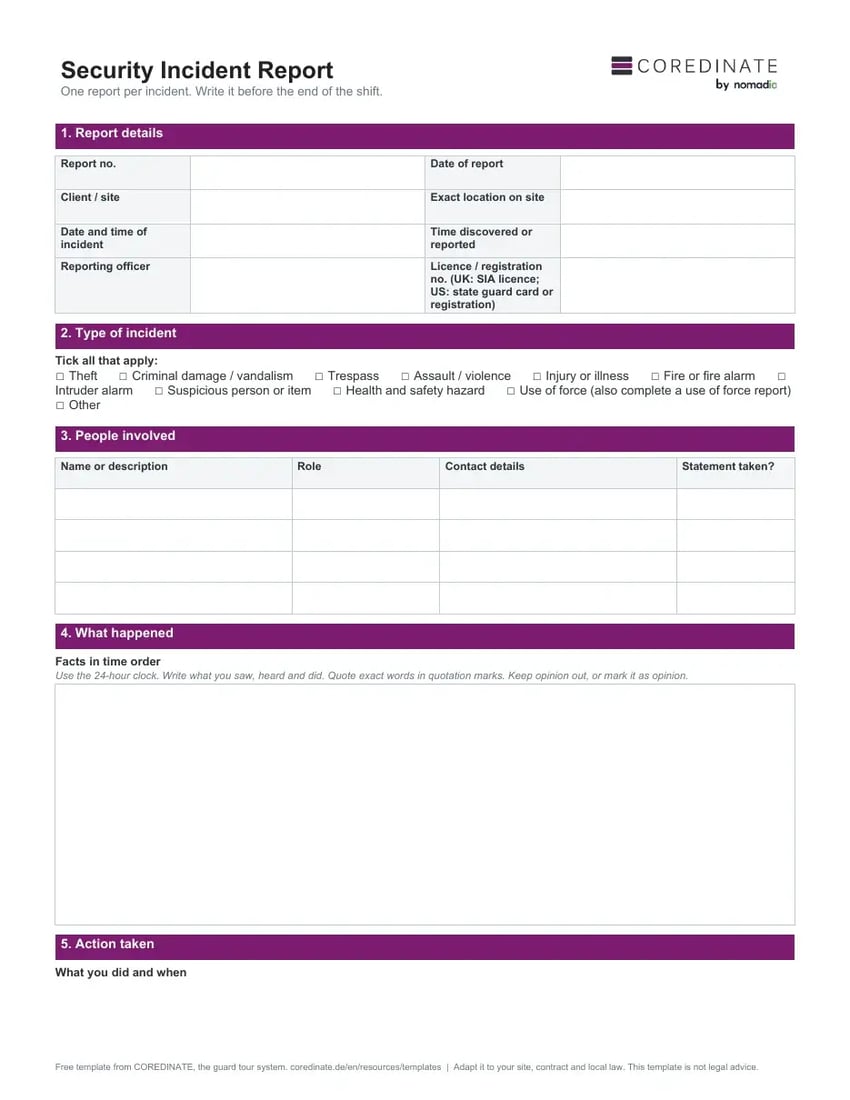
Sources
- CISA Office for Bombing Prevention: Bomb Threat Checklist (as of August 2025)
- CISA: Bomb Threat Guide, Version 1 (August 2025)
- DHS-DOJ Bomb Threat Stand-Off Card (as of August 2025)
- CISA: Bomb Threats, and What to Do: Bomb Threats, v2.0
- CISA: Suspicious Activity and Items (HOT, RAIN)
- ProtectUK (Counter Terrorism Policing, NaCTSO): Bomb threats; Bomb threats checklist (2022); Bomb Threat Action Card; Unattended and suspicious items; HOT principles poster; Evacuation, invacuation, lockdown, protected spaces; Search planning. ProtectUK's terms allow links to its home page only.
COREDINATE is not affiliated with CISA, DHS, NaCTSO or Counter Terrorism Policing, and they do not endorse this checklist. Checked 24 November 2026. Not legal advice.