Resources / Lone working
Lone worker policy template for security companies
A lone worker policy states how your company controls the risks of officers working alone: which posts may be worked alone, how often officers check in, how an alarm is raised and who responds. UK law requires a written health and safety policy once you employ five or more people. Our free template is written for guarding and patrol work.
What the law requires of a lone worker policy
A lone worker policy is not a separate legal requirement. The duty behind it comes from two general rules. The HSE's guidance on health and safety policies says every business must have a policy for managing health and safety, must write it down once it has five or more employees, and must share it and any changes with employees. The Management of Health and Safety at Work Regulations 1999 then require a suitable and sufficient risk assessment.
For lone working, the HSE's leaflet INDG73, Protecting lone workers, fills in what that means. You must assess and control the risks before anyone works alone, you cannot transfer that responsibility to the lone worker, and you must train, supervise and monitor lone workers, keep in touch with them and respond to any incident. INDG73 names security staff among people who work outside normal hours, and again among workers whose authority over customers raises the risk of violence.
A lone worker policy is therefore the part of your health and safety arrangements that turns those duties into rules an officer can follow on a night shift. It is not a separate legal document, and you can keep it as a section of your main policy or as a standalone procedure that the main policy refers to.
Policy, risk assessment and procedure: three documents, three readers
The risk assessment explains why a post is acceptable to work alone and what controls make it so; auditors and clients read it. The policy states the rules that follow from it; officers read it. The site procedure fixes the details for one assignment, such as the check-in interval and the escalation contact. Keeping them apart stops the policy from turning into a risk register nobody on shift will read. How to build the assessment for security posts is covered in our article on the lone working risk assessment for security officers.
What our lone worker policy template contains
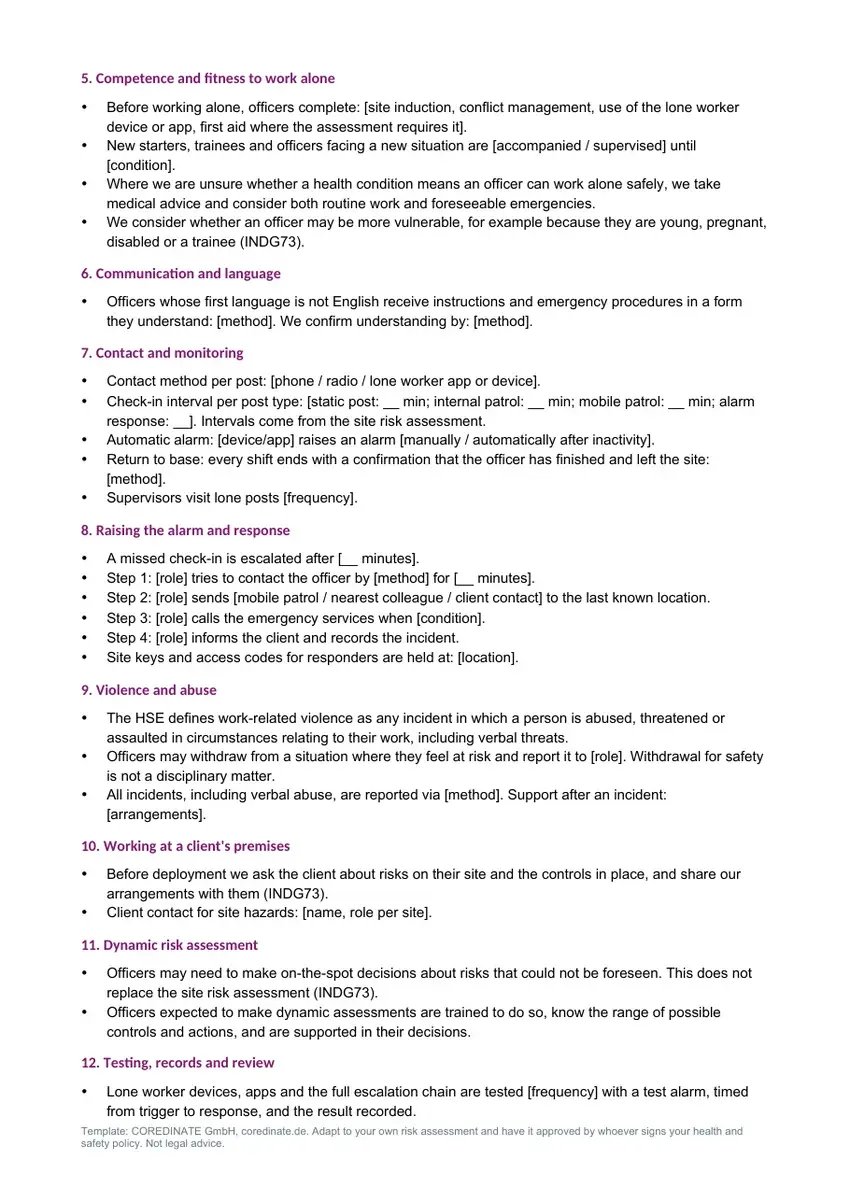
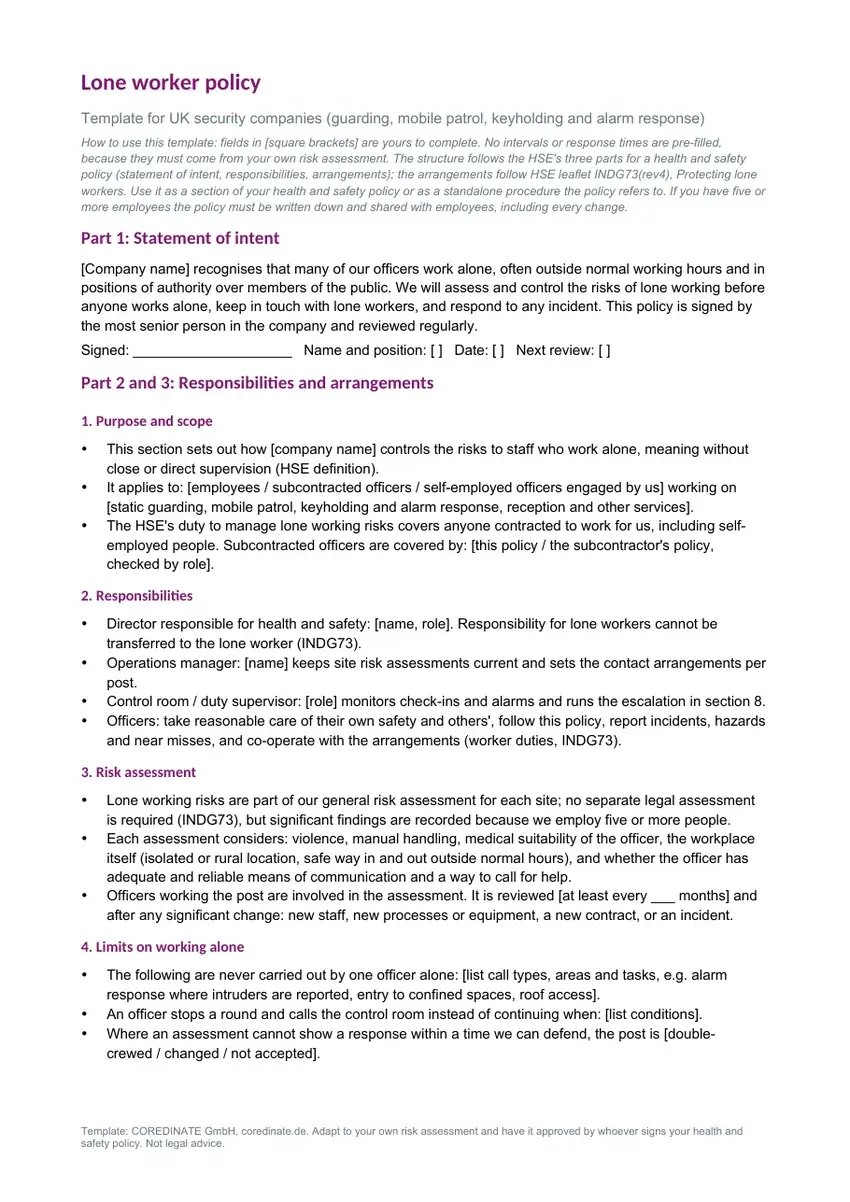
The template follows the three parts the HSE sets out for writing a health and safety policy: a signed statement of intent, named responsibilities and the practical arrangements. The arrangements part has twelve sections, and each one answers a specific item in the HSE's lone working guidance, so every clause can be traced back to a duty if an auditor asks why it is there.
| Section | What you fill in | HSE basis |
|---|---|---|
| 1. Purpose and scope | Which staff and activities the policy covers, including subcontracted officers | Duty covers anyone contracted to work for you, including the self-employed |
| 2. Responsibilities | Named roles for the director, operations manager, control room and officers | Responsibility cannot be transferred to the lone worker |
| 3. Risk assessment | How each site is assessed, when it is reviewed, how officers are involved | Include lone working in the risk assessment; involve workers; review after changes |
| 4. Limits on working alone | Tasks and call types that are never done alone, and when a round stops | Set limits on what can and cannot be done while working alone |
| 5. Competence and fitness | Training before solo deployment, supervision of new starters, medical suitability | Training, supervision at first, medical advice where unsure |
| 6. Communication and language | How instructions reach officers whose first language is not English | Information and training must be received and understood |
| 7. Contact and monitoring | Check-in intervals, the device or app used, return-to-base confirmation | Pre-agreed intervals of contact, alarm devices, return-to-base system |
| 8. Raising the alarm and response | What triggers escalation, who acts, in what order, within what time | Emergency procedures established, trained and practised |
| 9. Violence and abuse | Conflict management, withdrawal, reporting and support after an incident | Violence includes verbal threats; support workers after incidents |
| 10. Working at a client's premises | How client site hazards and controls are obtained and shared | Consult the other employer about risks and controls |
| 11. Dynamic risk assessment | When an officer may make an on-the-spot decision and the training they need | Dynamic assessment is no substitute; officers need training and support |
| 12. Testing, records and review | Test alarm dates, records kept, review triggers and sign-off | Regularly test systems and all emergency procedures |
Clauses a guarding company needs
General lone worker templates are written to fit every industry. A guarding company needs answers to questions that come from its own work: alarm response, keyholding and patrols of empty sites at night.
Which call types are never attended alone
The HSE tells employers to set limits on what can be done alone. In guarding, the obvious candidates are alarm response to a building where intruders are reported, keyholding call-outs to premises with a known history, and entry to roof spaces, plant rooms or confined areas. The template asks you to list them by name, because a policy that sets no limits has not made a decision.
A check-in interval with a number in it
"Regular contact" cannot be audited. The template has a field for the interval per post type and for the time after a missed check-in at which the control room escalates. The interval is your decision from the risk assessment; the HSE sets none.
Who owns a missed check-in
Escalation fails when it belongs to "the control room" in general. The template names a role for each step: who tries to contact the officer, who decides to send someone, who calls the emergency services and who informs the client.
Keys and access for the responder
A responder stuck at a locked gate cannot help anyone. The template asks where site keys and access codes are held, so that whoever is sent to a silent officer can get to them.
Proof that the system was tested
INDG73 asks for regular testing of technical solutions and all emergency procedures. The template records each test alarm with its date, the device, who received it and how long the chain took.
Download the lone worker policy template
The template is a Word document you can edit and a PDF to read before you start. Fields in square brackets are yours to complete; nothing in it is pre-filled with numbers, because intervals and response times have to come from your own risk assessment. Have it reviewed by whoever signs your health and safety policy before you issue it.
A matching lone working risk assessment template, with the HSE's columns and three worked rows for a night patrol, is available with our risk assessment article.
Turning the policy into records
A policy says officers check in every set number of minutes; an auditor asks you to show that they did on a given night. COREDINATE's guard tour and patrol system timestamps each checkpoint scan, shows the progress of every patrol live in the portal and writes scans, incidents and shift start and end into the daily occurrence book. On the same handset, its lone worker protection raises an automatic alarm after a period of inactivity, with a pre-warning to the officer first, and on compatible Crosscall phones a manual alarm button. What happens after the alarm, and who goes, is still defined by your policy.
Frequently asked questions
Is a lone worker policy a legal requirement in the UK?
Not as a separately named document. Every business must have a health and safety policy, written down once it has five or more employees, and must assess and control lone working risks. A lone worker policy is a practical way to record those arrangements.
What should a lone worker policy include?
Scope, named responsibilities, how risks are assessed, limits on what may be done alone, training and fitness, contact and monitoring arrangements, alarm and response procedures, violence reporting and support, arrangements at clients' premises, testing and review.
How often should a lone worker policy be reviewed?
The law sets no fixed interval. Review it when the risk assessment changes, for example after an incident, a new contract type or new equipment, and share every change with employees as the HSE requires.
Does the policy apply to subcontracted security officers?
The HSE says the duty to manage lone working risks applies to anyone contracted to work for you, including self-employed people. State in the scope how subcontracted officers are covered and who monitors them.
Is there an official HSE lone worker policy template?
The HSE publishes a general health and safety policy template in three parts: statement of intent, responsibilities and arrangements. Its lone working leaflet, INDG73, has no policy template. Our template uses the HSE's three-part structure and has to be adapted to your own risk assessment.
Make check-ins and patrols provable.
Test COREDINATE's guard tour and patrol system free for 14 days.