Security templates/Use of force report
Use of force report template for security officers
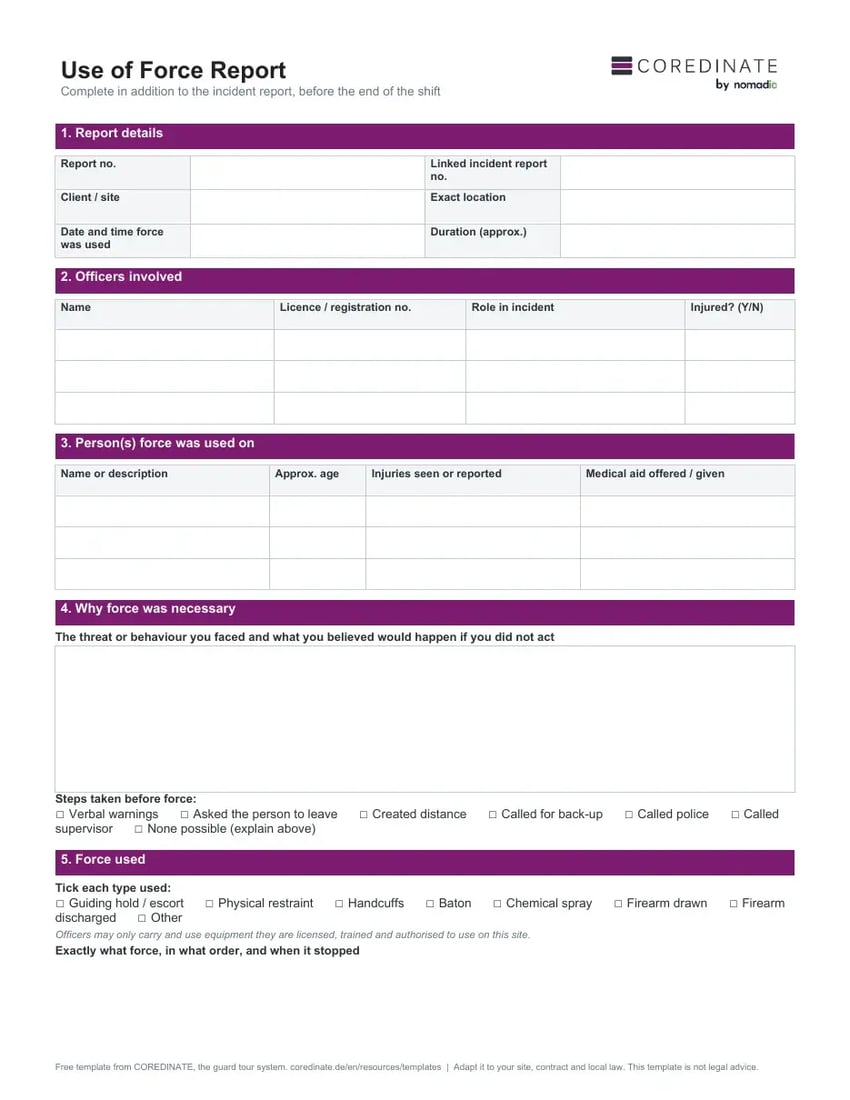
A use of force report records why a security officer used force, what force was used, for how long, what happened afterwards and who was told. Write it in addition to the incident report, before the shift ends. This free template has seven sections and covers the California BSIS and UK legal points.
Free, no sign-up. Every file has the blank form first and a filled-in worked example at the end. Edit the Word file to add your logo, site details and wording.
What a use of force report must show
The report has to let someone who was not there judge whether the force was necessary and proportionate. That means three things in writing: the threat the officer faced, what the officer tried before using force, and exactly what force was used and when it stopped. Injuries, medical aid, police handover and preserved footage complete the record.
- Report details
- Officers involved
- Person(s) force was used on
- Why force was necessary
- Force used
- Afterwards
- Reports to authorities
| Section | Why it is there |
|---|---|
| Why force was necessary | The officer's belief at the time is the centre of any later review. Describe behaviour and words, then what you believed would happen if you did nothing. |
| Steps before force | Warnings, a request to leave, distance, calling for back-up or police. If none was possible, say why. |
| Force used | Each technique or tool, in order, and when force stopped. Officers may only carry and use equipment they are licensed, trained and authorised to use on that site. |
| Afterwards | Detention or arrest, handover to police with the officer's badge number, crime or incident reference, ambulance, footage, witnesses. |
| Reports to authorities | Which regulator, safety authority and client were told, and on what date. |
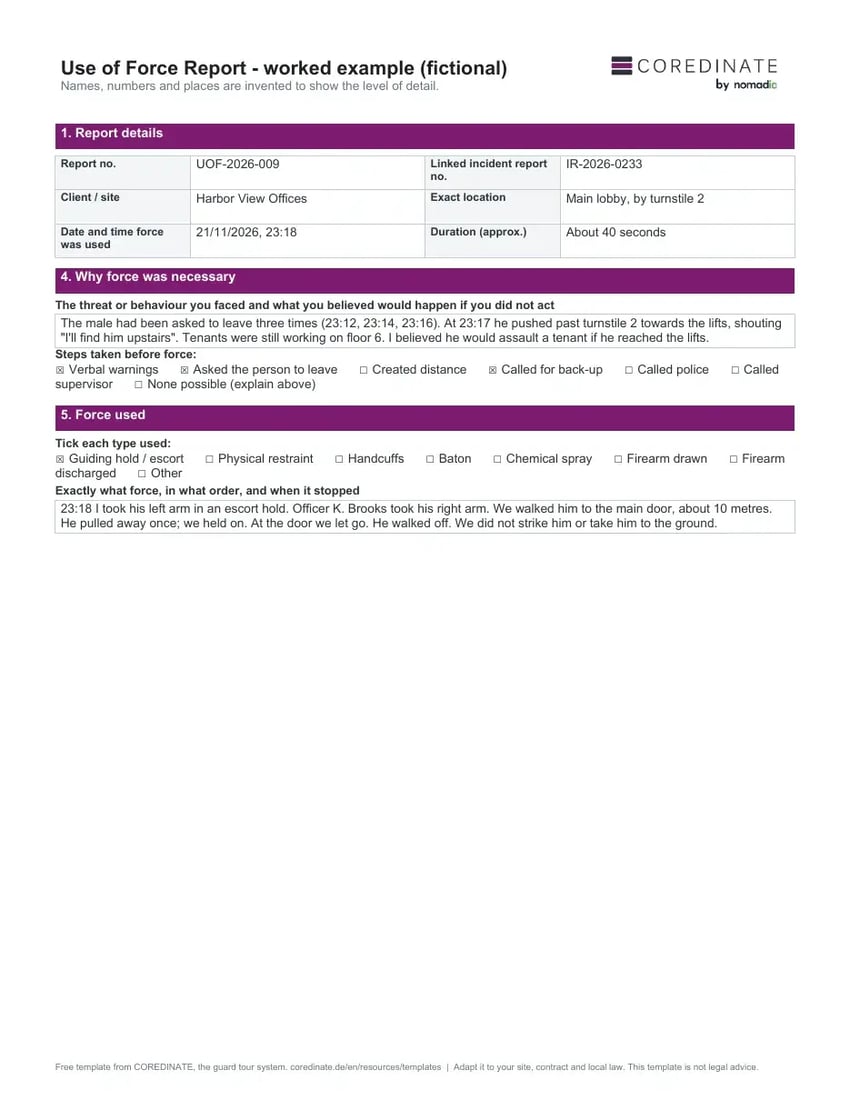
From the worked example in the download:
23:18 I took his left arm in an escort hold. Officer K. Brooks took his right arm. We walked him to the main door, about 10 metres. He pulled away once; we held on. At the door we let go. He walked off. We did not strike him or take him to the ground.
United States: state rules, with California as the clearest case
Use of force by private security is regulated state by state. California sets a written reporting deadline: under Business and Professions Code section 7583.2(f), as quoted on the BSIS incident report form, a private patrol operator must report any firearm discharge, or a physical altercation with a member of the public on duty, within seven business days.
The physical altercations that require a report are those that result in:
- the arrest of a security guard;
- the filing of a police report by a member of the public;
- a member of the public requiring any type of first aid or other medical attention;
- the discharge, suspension or reprimand of a security guard by the employer; or
- any physical use of force or violence on any person while on duty.
The form states that failure to report may result in a fine of $5,000. A guard involved in a firearm discharge, and the employer, must also report it within seven days to BSIS and the local police or sheriff under section 7583.4. BSIS takes reports by mail or by email (BSIS submission page). Outside California, check your state regulator and your client contract; the template's "Reports to authorities" table has space for both.
United Kingdom: reasonable force and citizen's arrest
In the UK, security officers rely on the general law on force and arrest that applies to everyone. Section 3 of the Criminal Law Act 1967 allows "such force as is reasonable in the circumstances in the prevention of crime" or in making or assisting a lawful arrest. In England and Wales, section 24A of the Police and Criminal Evidence Act 1984 lets a person other than a constable arrest someone for an indictable offence, but only if it is not reasonably practicable for a constable to do it and the arrest is necessary to prevent injury, loss or damage, or the person making off before a constable can take over.
The report should therefore show why force was reasonable at that moment and, after an arrest, why a police officer could not have made it. If a worker is injured, RIDDOR may apply: HSE treats a work-related act of physical violence that causes a reportable injury to a worker as a reportable accident, with deadlines on our incident report template page.
Template preview
Use of force reports in a guard tour app
A use of force report should reach a supervisor the same night, not at the end of the week. In COREDINATE's guard tour system, the report can be built as a flexible form with mandatory fields attached to an incident with photos. Give the incident type a high impact level and a notification rule emails the duty manager when it is logged. Configurable states let a manager review the report internally before the client sees it, and a case in the ticket system can track follow-up such as a regulator report.
Frequently asked questions
What is a use of force report?
A written record of an incident in which a security officer used physical force or a tool such as handcuffs or a baton. It explains why force was necessary, what was tried first, what force was used, injuries, medical aid, police involvement and who was notified.
When must a use of force report be written?
Before the end of the shift in which force was used, together with the incident report. In California, a private patrol operator must also send a written report to BSIS within seven business days when the altercation meets one of the conditions in B&P Code 7583.2(f), which include any physical use of force on duty.
Can UK security officers use force?
Yes, under the same law as any person: section 3 of the Criminal Law Act 1967 allows reasonable force in the prevention of crime or in making a lawful arrest. The force must be reasonable in the circumstances, and the report has to show why.
Who should review a use of force report?
The duty supervisor on the same night and a manager afterwards. The template has signature lines for officer, supervisor and manager, and a table for reports to regulators, safety authorities and the client.
Get use of force reports to a manager the same night
Order a free test kit and try mandatory-field forms, incident photos and instant notifications in COREDINATE's guard tour app for 14 days.