/Images/AI_Pictures/ricarda-schmidt-author.webp?width=30&name=ricarda-schmidt-author.webp) Ricarda Schmidt
Ricarda Schmidt
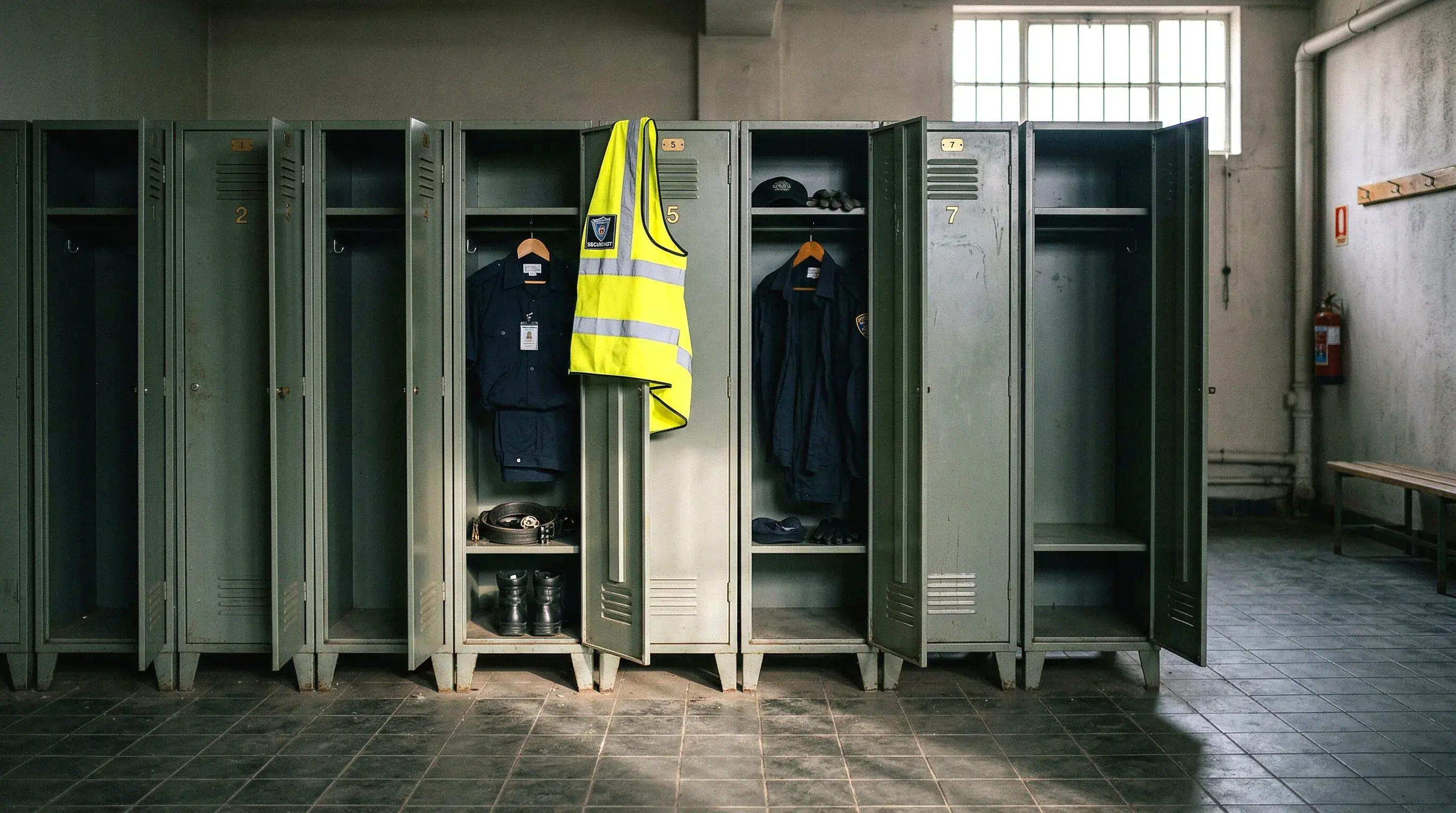
The UK's private security industry has more licence holders than ever: around 460,000 at the end of 2025, up 21% since 2020. A GBP 8.9 billion market with 6,500 companies. On the surface, healthy growth. But first-time licence applications fell 16% in a single year. The gap between what a security guard earns and the National Living Wage is about to shrink to 76 pence per hour. And a wave of new regulation, from Martyn's Law to mandatory business licensing, is adding demand for trained professionals at a time when fewer people are entering the profession.
Summary: The UK has a record 460,000 SIA licence holders, but first-time licence applications fell 16% in 2025 and growth is driven by renewals, not new entrants. With guards set to earn just 76p above minimum wage from April 2026 and Martyn's Law creating new demand for trained security professionals, operators need to do more with the teams they have.
/Images/Icons/Schichtplanung_OWKS_Icon.svg) Where the Guards Are Going
Where the Guards Are Going
A security guard in the UK earns an average of GBP 13.47 per hour (Indeed UK). From April 2026, the National Living Wage rises to GBP 12.71. That leaves a gap of 76 pence per hour for a licensed, regulated, physically demanding job with 12-hour shifts and routine exposure to verbal and physical abuse.
The SIA's sector profile is direct about where officers go when they leave: warehouse work, delivery driving, logistics, supermarkets. These jobs offer comparable or higher pay, sociable hours, career progression, and no SIA licence requirement. An SIA licence costs GBP 204 and requires weeks of training. A warehouse job starts on day one.
On the employer side, National Insurance contributions jumped from 13.8% to 15% in April 2025, with the threshold dropping from GBP 9,100 to GBP 5,000. Companies are absorbing higher employment costs with little room to raise wages. The squeeze runs both ways: operators cannot offer more, and officers can earn the same or better elsewhere with less hassle.
The SIA sector profile also notes that 10 to 15% of sector staff who left during the pandemic did not return, and that a significant share of security work relies on zero-hours contracts, which compounds instability. As of 2021, 68% of security officers had received no additional training beyond their initial SIA qualification (IFSEC Global). Without a visible career path, the job stays entry-level in practice, regardless of the responsibilities it carries. (The SIA has since launched a training framework review, which may change this.)
/Images/Icons/Auswertungen_Berichte_OWKS_Icon.svg) Fewer People Coming In
Fewer People Coming In
First-time SIA licence applications fell from 94,332 in 2024 to 79,455 in 2025, a decline of 15.8% (SIA licence data, GOV.UK). The SIA's Business Plan for 2025-26 projects 75,000 first-time applications, confirming the downward trajectory.
Total licence holder numbers are still growing: from 365,226 in December 2020 to roughly 460,000 by end 2025, a 21% increase (SIA Annual Report 2024-25). But that growth is driven by renewals, not new blood. The industry is holding on to existing licence holders while replacing departures more slowly. Young workers aged 18 to 21 make up roughly 5% of licence holders, a consistently small share. The core of the workforce sits in the 22 to 40 age range, accounting for over half of all holders.
In November 2022, the BSIA identified a gap of 62,000 officers and launched its "People, Property, Places: Professionally Protected" recruitment campaign. The industry subsequently recruited an estimated 65,000 in six months (IFSEC Global). That was a reactive surge driven by post-pandemic bounce-back demand, not evidence of a healthy pipeline. The 16% year-on-year drop in first-time licence applications tells a different story: fewer people are choosing security as a career path.
/Images/Icons/Datenschutz_OWKS_Icon.svg) More Demand, Higher Barriers
More Demand, Higher Barriers
The Terrorism (Protection of Premises) Act 2025, known as Martyn's Law, received Royal Assent on 3 April 2025. An estimated 178,900 to 300,000 premises fall under its scope (estimates vary because enforcement guidance has not been published). Standard-tier venues (200 to 799 capacity) must have evacuation and lockdown procedures in place. Enhanced-tier venues (800 and above) require full risk assessments. Penalties reach GBP 18 million or 5% of worldwide revenue. Enforcement is expected from 2027, with the SIA designated as the regulator.
At the same time, the SIA is overhauling training requirements: a new framework with a four-week foundational course and role-specific specialist training is expected from summer 2026. The SIA is reviewing whether existing licence holders will need to requalify under the new standards. In-house CCTV operators, previously exempt, will also require SIA licensing.
Mandatory business licensing for security companies is under consultation since December 2025, with a decision expected Q3 2026 and full rollout by 2029. This would build on the existing Approved Contractor Scheme (ACS) and add another layer of compliance for operators competing for contracts.
SIA vetting criteria were tightened in December 2025: overseas criminal record checks now cover 10 years instead of 5, and the offence list was expanded. BS 7858 pre-employment screening remains the baseline standard. Licence fees rise to GBP 204 in April 2026.
Each of these changes raises the quality floor. They also raise the barrier to entry and the cost of operation. For an industry that already struggles to attract new entrants at current pay levels, higher barriers mean the pipeline narrows further, even as the demand for qualified professionals grows.
/Images/Icons/Arbeiten_im_Portal_OWKS_Icon.svg) Making Smaller Teams Effective
Making Smaller Teams Effective
When staff turnover is high, the most expensive loss is not recruiting the replacement. It is the site-specific knowledge that leaves with every departing officer: which doors need checking twice, which client expects photo documentation at every checkpoint, which access route closes after 22:00. Rebuilding that knowledge takes weeks of shadowing and a reliable senior colleague, neither of which are available when rosters are already stretched.
COREDINATE addresses this operationally:
- Site knowledge stays in the system, not in people's heads: Tasks and checklists are bound to checkpoint locations. When a new officer scans a checkpoint, the system shows exactly what needs to happen there. Procedures survive staff changes without relying on verbal handovers or printed folders.
- Scheduling that absorbs disruption: When an officer calls in sick at 05:00, the duty roster needs restructuring immediately. Digital scheduling with real-time availability replaces phone trees and spreadsheet coordination.
- Lone worker protection for solo patrols: A dead man's switch triggers an alarm if an officer becomes unresponsive during a solo shift. With Martyn's Law raising accountability for premises security, documented proof of officer welfare monitoring becomes a compliance factor.
- Audit-ready documentation: SIA inspections, ACS assessments, client reviews, Martyn's Law compliance: all require evidence trails. Automated patrol logs, timestamped checkpoint scans, and incident reports generate that evidence as a byproduct of daily operations.
- Clients check status themselves: A self-service portal gives clients direct access to patrol data and reports. Fewer inbound calls asking "was my site covered last night?" frees operations staff for actual operations.
The net effect is operational: the same team covers more ground with better documentation, and site-specific knowledge does not walk out the door when someone hands in their notice.
Frequently Asked Questions
How big is the UK private security industry?
The UK private security market is valued at GBP 8.9 billion (IBISWorld 2025-26) with 6,528 registered businesses. The SIA reported around 460,000 active licence holders at the end of 2025, up 21% from 365,226 in December 2020. BSIA members provide over 70% of private security services by turnover.
Is there a workforce shortage in UK security?
The overall licence holder count is at a record high, but structural problems persist. First-time licence applications fell 16% in a single year (94,332 in 2024 to 79,455 in 2025, SIA data). Growth is driven by renewals, not new entrants. The SIA's own sector profile notes that guards frequently leave for warehouse, logistics, and retail roles that offer comparable or higher pay without licensing requirements. High turnover remains an acknowledged industry challenge.
How are UK security companies responding to staffing challenges?
Companies are investing in retention through better scheduling technology, career development pathways, and operational efficiency tools. Guard tour systems and automated reporting reduce administrative burden so existing teams can cover more ground. Lone worker protection systems address officer safety. However, the fundamental pay compression, with guards earning roughly GBP 0.76 per hour above National Living Wage from April 2026, remains largely unresolved, and new regulations (Martyn's Law, SIA training reform, business licensing) are adding both demand and cost.
Run leaner operations without losing control
Guard tour, scheduling, time tracking, and reporting in one platform. 14-day free trial.
Start free trial →Or call us: +49 (0) 9842 80491-20
/Images/Product_images/Testset_incl_Icons_400Pixel.webp)
You are not yet using the COREDINATE® guard control system? Then it's time to put our test set through its paces for 14 days free of charge and without obligation.
/Images/Icons/Social%20Media/facebook_gray.svg)
/Images/Icons/Social%20Media/linkedin_gray.svg)
/Images/Icons/Social%20Media/x_gray.svg)
/Images/Icons/Social%20Media/xing_gray.svg)