Security templates/Workplace violence prevention plan
Workplace violence prevention plan template for security teams
Since July 1, 2024, California employers need a written workplace violence prevention plan and a violent incident log under Labor Code 6401.9, unless an exemption applies. This free template follows the 13 elements the statute lists and adds what security contractors need: client sites, controlling employers and hazards per post.
Free, no sign-up, US Letter. The plan file includes the incident log as an appendix and a worked example for a fictional guard company. Not legal advice.
Who needs a workplace violence prevention plan
Labor Code 6401.9 applies to all employers, employees, places of employment and employer-provided housing in California. The exemptions are narrow, and a security company with officers on client sites will rarely fit one.
Covered
- Security contractors, for every site where their officers work
- In-house security teams of covered employers
- Employer-provided housing
- Sites with fewer than 10 employees that are open to the public
Exempt (6401.9(b)(2))
- Health care operations covered by title 8 section 3342, and employers that comply with it
- Corrections facilities and qualifying law enforcement agencies that comply with section 3203
- Employees teleworking from a place of their choice
- Places with fewer than 10 employees at any time, not open to the public, that comply with section 3203
Cal/OSHA can still order an exempt employer to comply (6401.9(b)(3)). On its general industry page, Cal/OSHA lists "threats and acts of violence directed at security guards" as an example of Type 1 violence, the type committed by people with no legitimate business at the site. For a guard company, that is the core risk of the job.
A standard is on the way. The statute required the Standards Board to adopt one by December 31, 2026. Cal/OSHA's rulemaking page shows discussion drafts of a title 8 section 3343 from April, July and September 2026, still at the advisory stage. Until a standard is adopted, the statute alone sets the requirements. Check the page before your next plan review.
The 13 elements the plan must contain
Subdivision (c)(2) lists them as (A) to (M). The template follows the same order and labels every section with the subdivision it answers, so the plan can be checked against the statute line by line.
- (A) People responsible
Names or job titles of the people who implement the plan, and their roles if there are several. For a guard company: who owns the plan, who inspects posts, who keeps the log.
- (B) Employee involvement
How officers and their representatives help find and correct hazards, design training and investigate incidents. Officers on night posts see hazards the office does not.
- (C) Coordination with other employers
How you work with clients and other employers on the same site, so everyone knows their role and every incident is reported, investigated and recorded.
- (D) Reports and anti-retaliation
How you accept and respond to reports of workplace violence, and how you prohibit retaliation against the officer who reports.
- (E) Compliance
How supervisors and officers are made to follow the plan, in line with your Injury and Illness Prevention Program.
- (F) Communication
How officers report violence, threats or concerns to you or to law enforcement without fear of reprisal, and how they learn the result of an investigation.
- (G) Emergency response
How employees are alerted to an emergency, evacuation or sheltering, and how to get help from security staff and law enforcement.
- (H) Training
How the training required by subdivision (e) is developed and delivered.
- (I) Hazard identification
Scheduled inspections and employee reports. Inspect when the plan is set up, after every incident and whenever a new hazard comes to light.
- (J) Hazard correction
How identified hazards are corrected in a timely manner.
- (K) Post-incident response
What happens after an incident, including the investigation.
- (L) Plan review
Review at least once a year, after an incident and whenever a deficiency shows, with employees involved.
- (M) Other requirements
Anything Cal/OSHA or the Standards Board adds. The general industry standard is still a draft.
Contract security: one plan, many client sites
The statute was written for an employer with its own workplace. A guard company has dozens, each owned and run by a client. Three parts of 6401.9 decide whether the plan works in that setting.
Hazards per work area
The plan must be "specific to the hazards and corrective measures for each work area and operation" ((c)(1)(B)). Cal/OSHA's FAQ repeats it when asked whether a corporate plan can cover all sites. A gatehouse at a logistics hub at night and a reception desk in an office tower do not share hazards. The template's hazard table has a column for the site, and the details belong in the post orders of each post.
Coordination with the client
Element (C) asks how you coordinate with other employers so that every incident involving any employee is reported, investigated and recorded. Agree with each client, in writing, who tells whom and within what time. Section 3 of the template is a table with one line per client site.
The controlling employer gets a copy of the log
At a multiemployer worksite, the employer whose employee experienced the violence records it and gives a copy of the log to the controlling employer ((d)(1)(C)). For an officer threatened at a client's gate, that is you recording and the client receiving. The template's incident log has a line for the date and recipient of that copy.
Training and records
Training happens when the plan is first set up, every year after that, and again when a new hazard is found or the plan changes ((e)(2), (e)(3)). It has to include a chance to ask questions of someone who knows the plan.
Hazard identification, evaluation, correction
5 years
Minimum retention, (f)(1).
Training records
1 year
Dates, contents, trainers and attendees with job titles, (f)(2).
Violent incident log
5 years
Reviewed at every plan review, (d)(1)(B) and (f)(3).
Incident investigations
5 years
Without medical information, (f)(4).
Employees and their representatives can ask for the hazard records, training records and the log. They must be available for examination and copying, without cost, within 15 calendar days ((f)(6)). Keep them in one place, so a request can be answered inside that deadline.
Hospitals: section 3342 and the Joint Commission
Hospital security teams work under different rules. In California, health care facilities covered by title 8 section 3342 are exempt from 6401.9 and follow 3342, which has its own plan and violent incident log. Cal/OSHA's model plan for general industry tells these employers not to use it. Nationwide, accredited hospitals have followed the Joint Commission's workplace violence standards since January 1, 2022. The Joint Commission has since extended them to its other accreditation programs.
| Labor Code 6401.9 | Joint Commission (hospitals) | |
|---|---|---|
| Who | California employers outside the exemptions | Accredited hospitals and critical access hospitals |
| Definition | Violence or threat of violence at a place of employment, in four types | Also verbal, nonverbal and written aggression, bullying, sabotage and sexual harassment |
| Program | Named people responsible, employee involvement | Led by a designated individual, developed by a multidisciplinary team (LD.03.01.01 EP 9) |
| Incidents | Violent incident log with fixed fields | Process to report, monitor and investigate incidents (EC.04.01.01 EP 1, EP 6) |
| Review | At least annually, after incidents, on deficiencies | Annual worksite analysis with actions (EC.02.01.01 EP 17) |
| Training | Initially, annually, on new hazards and plan changes | At hire, annually and when the program changes (HR.01.05.03 EP 29) |
The Joint Commission now presents the same requirements as National Performance Goal 2a. Element numbers come from the 2021 report and may have moved in the current manual.
What is in the download
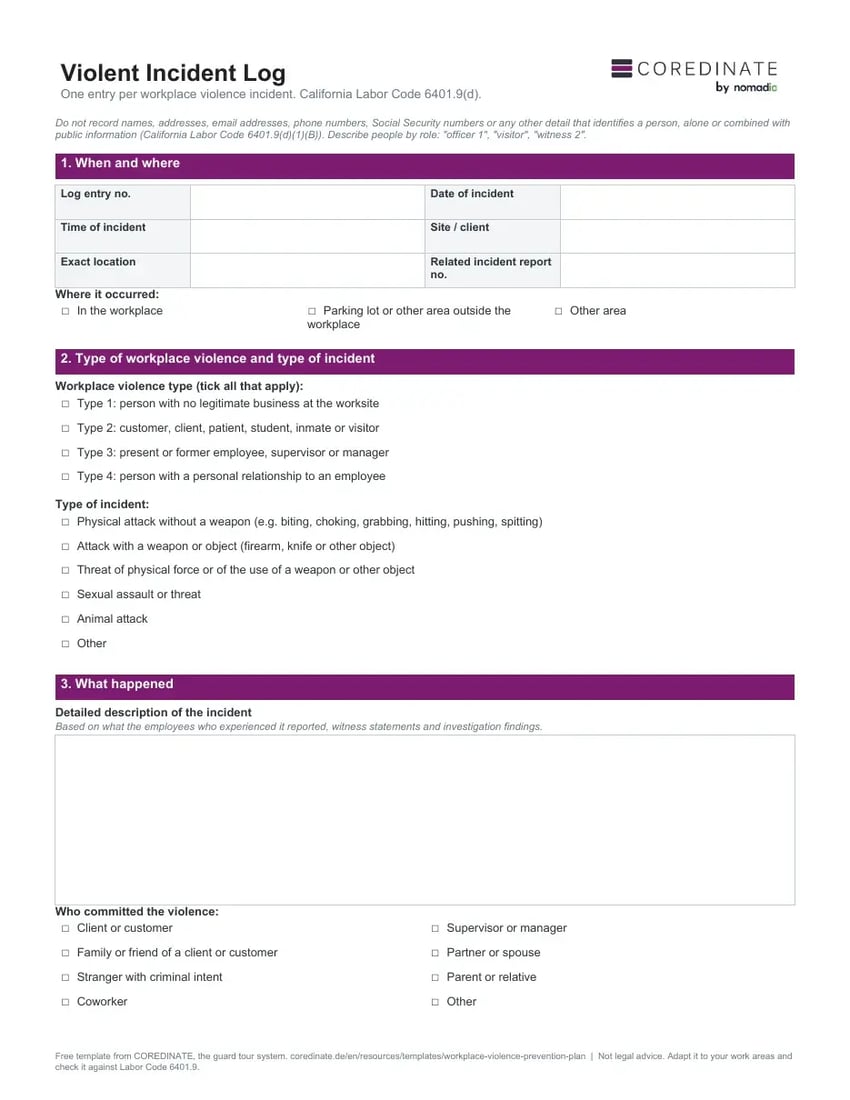
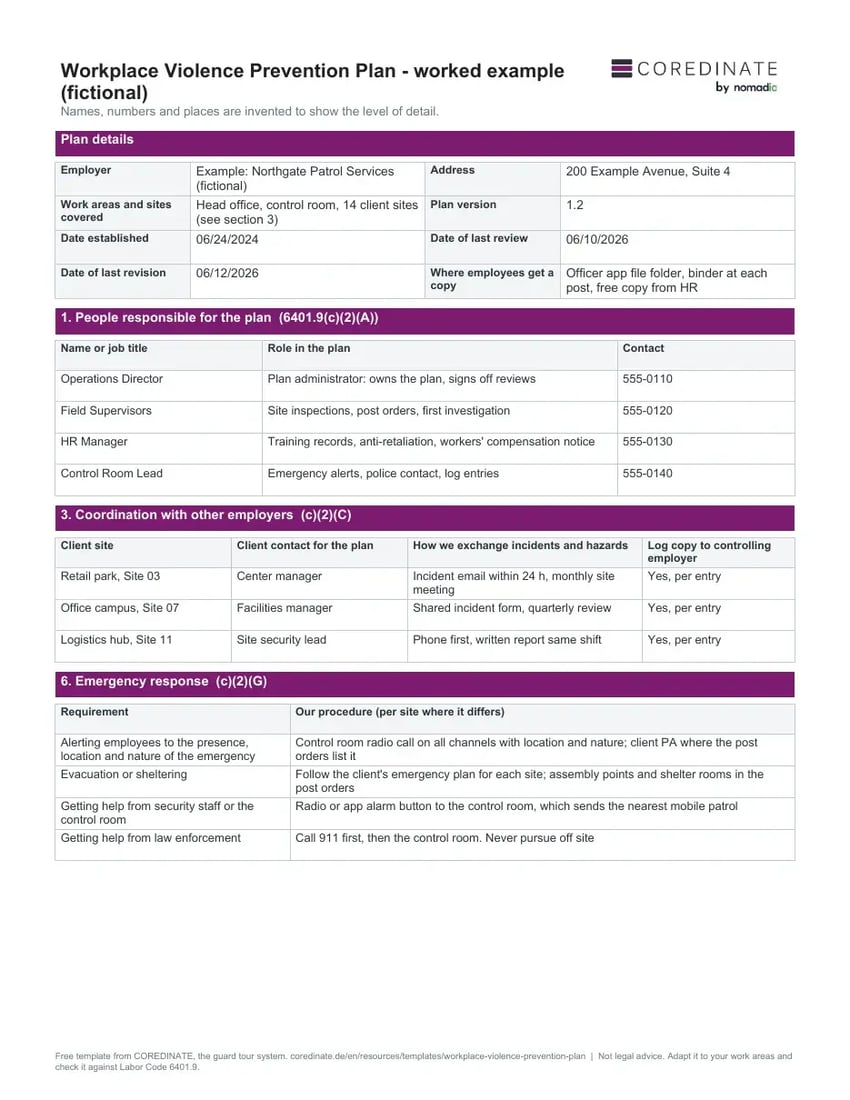
Nine pages in US Letter: the blank plan on three, the violent incident log on two, then a worked example for a fictional guard company: selected plan sections and one full log entry. Each plan section names the subdivision it answers, and grey hints say what belongs there.
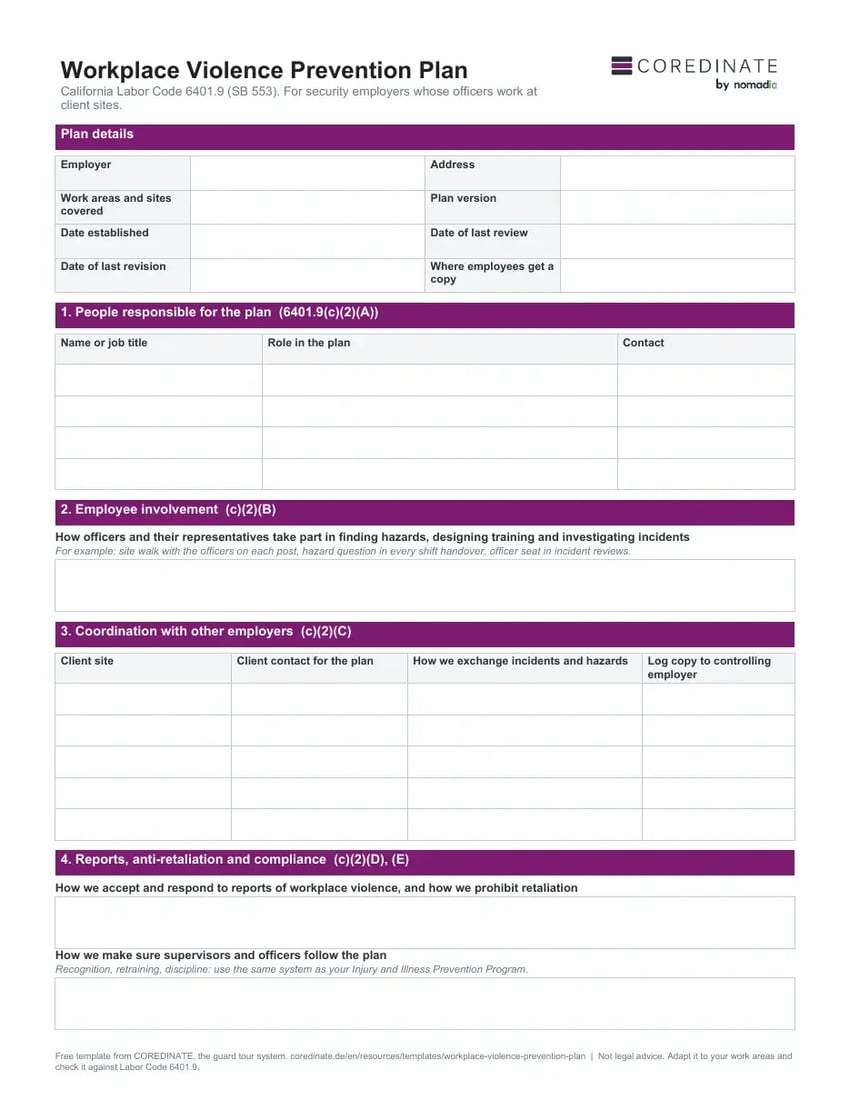
- People responsible
- Employee involvement
- Coordination with other employers
- Reports, anti-retaliation, compliance
- Communication with employees
- Emergency response
- Training
- Hazard identification and evaluation
- Hazard correction
- Post-incident response and investigation
- Plan review
- Records
Above section 1 sit the plan details: version, review dates and where employees get a copy. The incident log follows as an appendix.
We wrote the template from the statute. Cal/OSHA's own model plan may only be used for nonprofit and educational purposes under its copyright notice, so none of its text is copied here.
Where a guard tour system helps
The plan is paperwork; what makes it work is how fast an incident gets from the post to the person responsible. In COREDINATE, the guard tour and patrol system, officers record an incident from anywhere in the app, with photos. Incident types carry an impact level, and a notification rule can email the supervisor as soon as a high-impact incident comes in. Incidents can go through states such as internal review before a client sees them.
Officers who work alone at night can carry the lone worker alarm: a manual alarm button on supported devices and an automatic alarm after a period of inactivity, shown on a map in the portal. Plan changes and new hazards reach every officer as messages that they confirm with a signature, which is a record of who has read them.
One thing stays manual. An incident report names people; the violent incident log must not. Write the log entry from the report and leave every identifier out.
Frequently asked questions
Is SB 553 the same as Labor Code 6401.9?
SB 553 is the 2023 bill. It created Labor Code section 6401.9 and amended section 6401.7. The plan, log, training and record requirements in 6401.9 have been enforceable since July 1, 2024.
Do we have to use Cal/OSHA's model plan?
No. Cal/OSHA's FAQ says employers may write their own plan, use another template or add the plan to their IIPP as a separate section. Using the model plan does not by itself make an employer compliant, and the same is true of this template.
Can a security company use one plan for all client sites?
One plan can cover all sites if it is specific to the hazards and corrective measures of each work area and operation, as 6401.9(c)(1)(B) requires. In practice that means a site section for every post with its own hazards.
Who keeps the violent incident log when our officer is hurt at a client site?
The employer whose employee experienced the violence records it in its own log. At a multiemployer worksite it must also give a copy of that log to the controlling employer (6401.9(d)(1)(C)).
Is this template legal advice?
No. It is a working document built from the text of Labor Code 6401.9. Have it checked by someone who knows your operations and California employment law before you rely on it.
Get incidents from the post to the plan owner during the shift
Order a free test kit and try incident logging with photos, notification rules and the lone worker alarm in COREDINATE's guard tour app for 14 days.
More security templates
All security templates →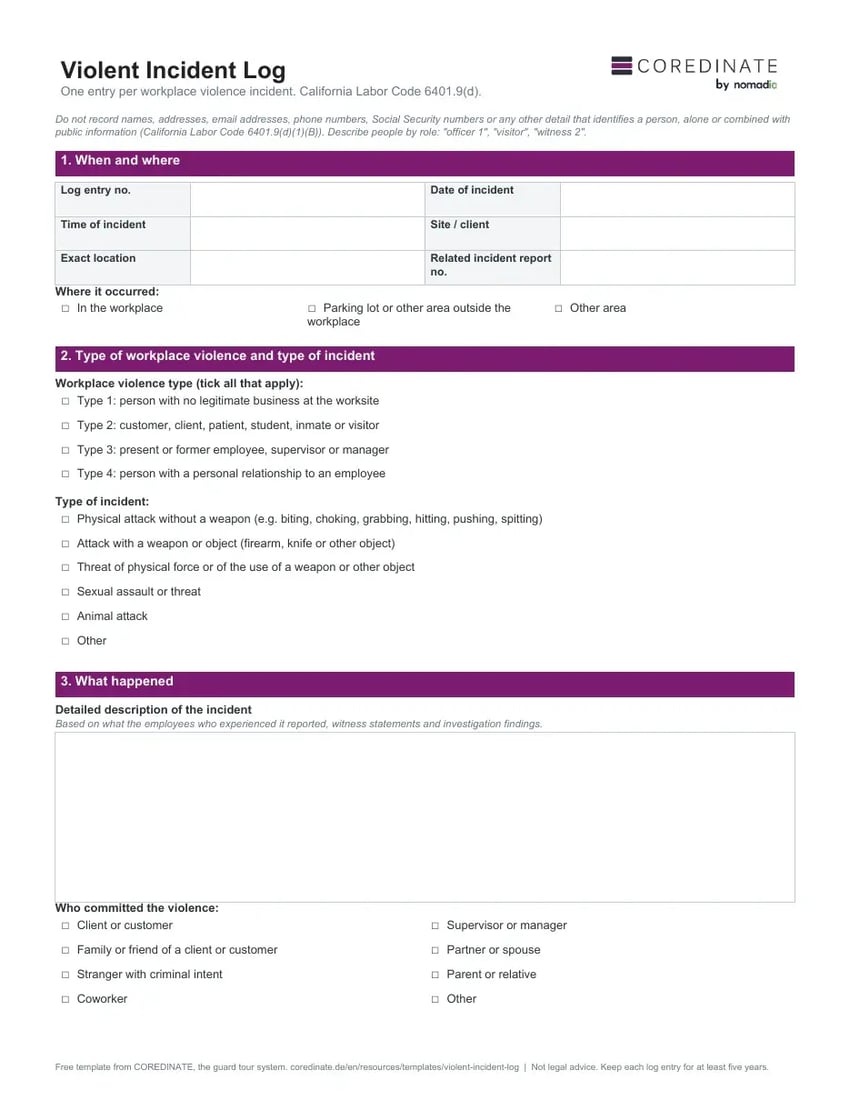
Sources
- California Labor Code section 6401.9 (added by SB 553, Stats. 2023, Ch. 289)
- Cal/OSHA, Workplace Violence Prevention for General Industry (Non-Health Care Settings)
- Cal/OSHA, Frequently Asked Questions about Workplace Violence Prevention in General Industry
- Cal/OSHA, Workplace Violence Prevention in General Industry: advisory meetings and drafts of section 3343
- California Code of Regulations, title 8, section 3342, Violence Prevention in Health Care
- The Joint Commission, R3 Report Issue 30: Workplace Violence Prevention Standards (June 2021)
- The Joint Commission, National Performance Goal 2a: Preventing Workplace Violence
Read 19.11.2026. This page and the template are not legal advice.