Security templates/Fire watch log
Fire watch log template
A fire watch log is the written record of every patrol made while a building's fire protection is out of service or hot work is going on: who was on duty, when each round started and ended, which areas were checked and what was found. Fire officials can ask to see it at any time.
Free, no sign-up. Six pages: information sheet, personnel and route, end of fire watch, a patrol log page to copy as often as the interval needs, then the same pages filled in with a fictional sprinkler impairment.
What a fire watch log must record
The only IFC section on fire watch records we found quoted in public sources is 3305.5.3, for construction sites. For everything else, the content of the log comes from the fire department that orders the watch. Across the guidance we read, the same eight entries come back, and the template has a field for each.
| Entry | Who asks for it |
|---|---|
| Address and the area under fire watch | Carroll County Fire Marshal (Georgia) log contents |
| Names of everyone on duty, with company and license numbers | California HCAI CAN 9-901.7 (health facilities), information sheet |
| Date and time of each duty period | Carroll County; IFC 3305.5.3 for construction sites, as quoted by the City of Gaffney |
| Start and end time of every round | Carroll County: "beginning and ending times of each patrol" |
| Areas checked and each building entered | IFC 3305.5.3: "each time the site was patrolled and each time a structure was entered and inspected" |
| Hazards found and what was done | City of Gaffney: document all issues and correct them if possible, for example a blocked exit |
| Emergency phone directory | CAL FIRE San Luis Obispo and HCAI: names and numbers for emergency calls in the log book |
| How and when the fire watch ended | HCAI: written termination only; Carroll County: contractor confirmation or inspection |
HCAI adds a detail worth copying: each timed signature on the log confirms a complete check of the building. A line in the log is a claim that the whole route was walked, so it should never be filled in ahead of time or from memory at the end of a shift.
When a fire watch is required
Four situations come up in the codes and guidance we read. Which code applies depends on the edition your state or city adopted.
| Situation | Rule | Who decides |
|---|---|---|
| Sprinkler, fire alarm or other required system out of service | IFC 901.7: notify the fire department and fire code official immediately | Fire code official: evacuate or fire watch |
| Health care buildings (Medicare and Medicaid) | CMS survey forms: fire alarm out more than 4 hours, sprinklers more than 10 hours in 24 hours | Fire watch or evacuation |
| Welding, cutting and other hot work | OSHA 29 CFR 1910.252: appreciable combustibles within 35 feet and other conditions; at least 30 minutes after the work | Employer, through the hot work permit |
| Assembly, construction and demolition | IFC 403.11.1 and 3305.5, where the fire code official requires it | Fire code official |
Thresholds, sources and the duties of the person on watch are on the page fire watch requirements.
How often a fire watch patrols
No national rule sets the interval. The fire code official does, and the published guidance falls into four bands.
Sleeping or dependent occupants, assembly
Continuous
Carroll County, Georgia: where people sleep, cannot leave without help, or gather in large numbers.
Factory and storage buildings
30 min
Carroll County for F-1, F-2 and storage occupancies. The City of Gaffney asks for checks every 30 to 60 minutes.
Everything else
60 min
At least once an hour through the whole building, basements and penthouses included (CAL FIRE San Luis Obispo; HCAI for the health facilities it regulates).
Hot work
+30 min
OSHA 1910.252: the watch stays at least half an hour after welding or cutting ends.
Ask for the interval in writing before the first round and write it into section 1 of the log. If an inspector later finds a 45-minute gap, the log should show which interval was ordered and by whom.
A fire watch from start to finish
- System out of serviceThe fire department and fire code official must be told immediately (IFC 901.7).Note the time, the person you spoke to and any reference number.
- Official decidesEvacuate the area, or post an approved fire watch for everyone left unprotected.Write down the patrol interval and who set it.
- Before the first roundThe owner instructs the watch: how to call the fire department, which areas to patrol, how to alert occupants, where the extinguishers are (HCAI, CAL FIRE San Luis Obispo).Fill in the contacts, the personnel and the patrol route.
- Every roundThe watch patrols the whole route and keeps exits clear. Fire watch is the only duty (IFC 901.7).One line per round: start, end, areas, findings, action, initials.
- Fire or smoke foundCall 911 with the exact address, say the fire protection system is impaired, start the evacuation (Carroll County).Log the time of the call. Use the incident report for the details.
- Shift changePass on special orders and stay on duty until properly relieved (HCAI).Both officers enter their on-duty and off-duty times.
- System back in serviceThe fire watch continues until the authority ends it, in writing where HCAI rules apply.Section 5: who restored the system, who ended the watch, reference.
What is in the template
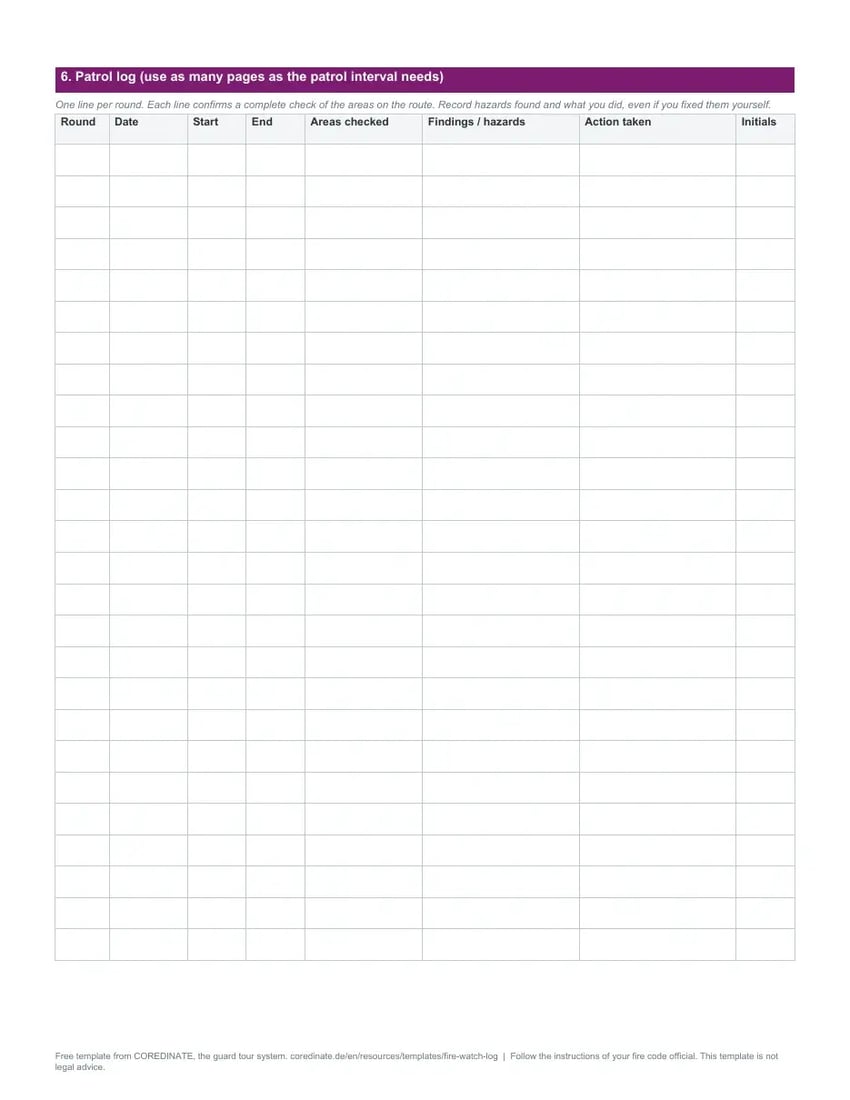
The Word file is meant to be edited: add your logo, the site's areas and the interval the fire marshal set. The patrol log has its own page with 26 lines. At 30-minute rounds that is about half a day, so print as many log pages as the interval needs and keep the information sheet as the cover.
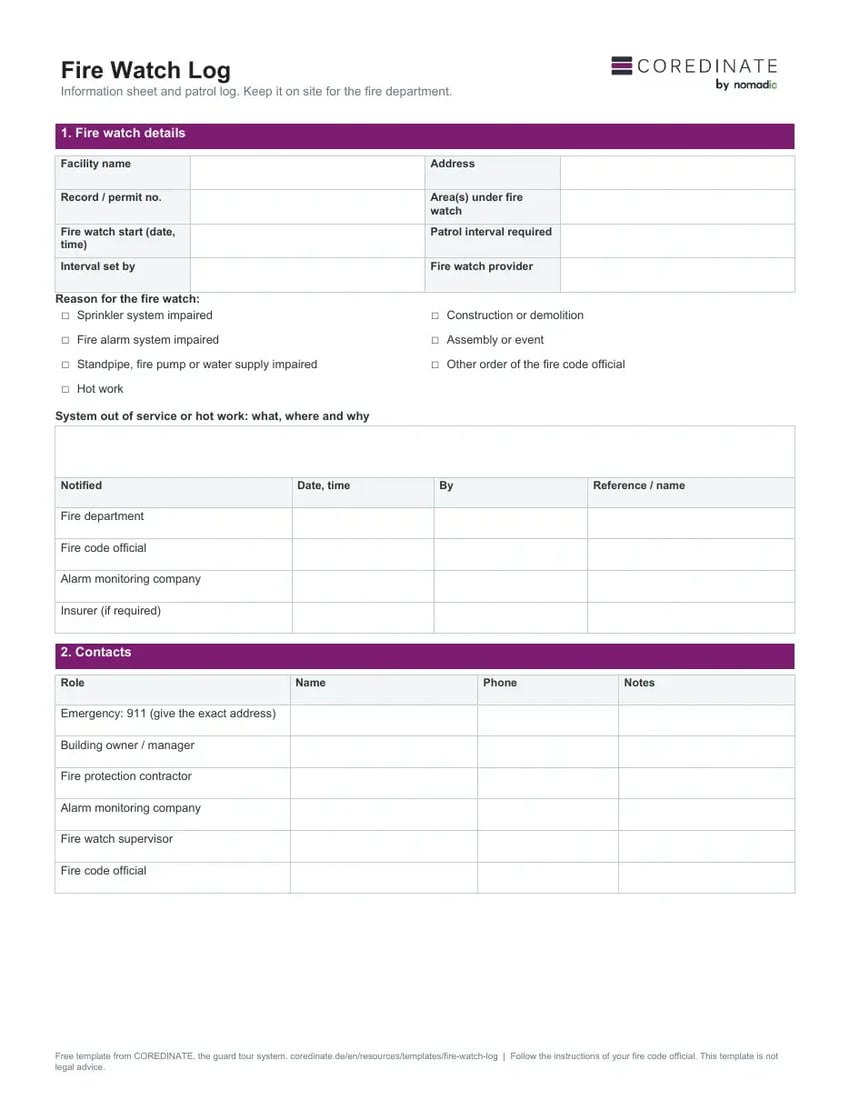
- Fire watch details, reason and notifications
- Contacts
- Fire watch personnel
- Patrol route and what to check
- End of fire watch and sign-off
- Patrol log, one line per round
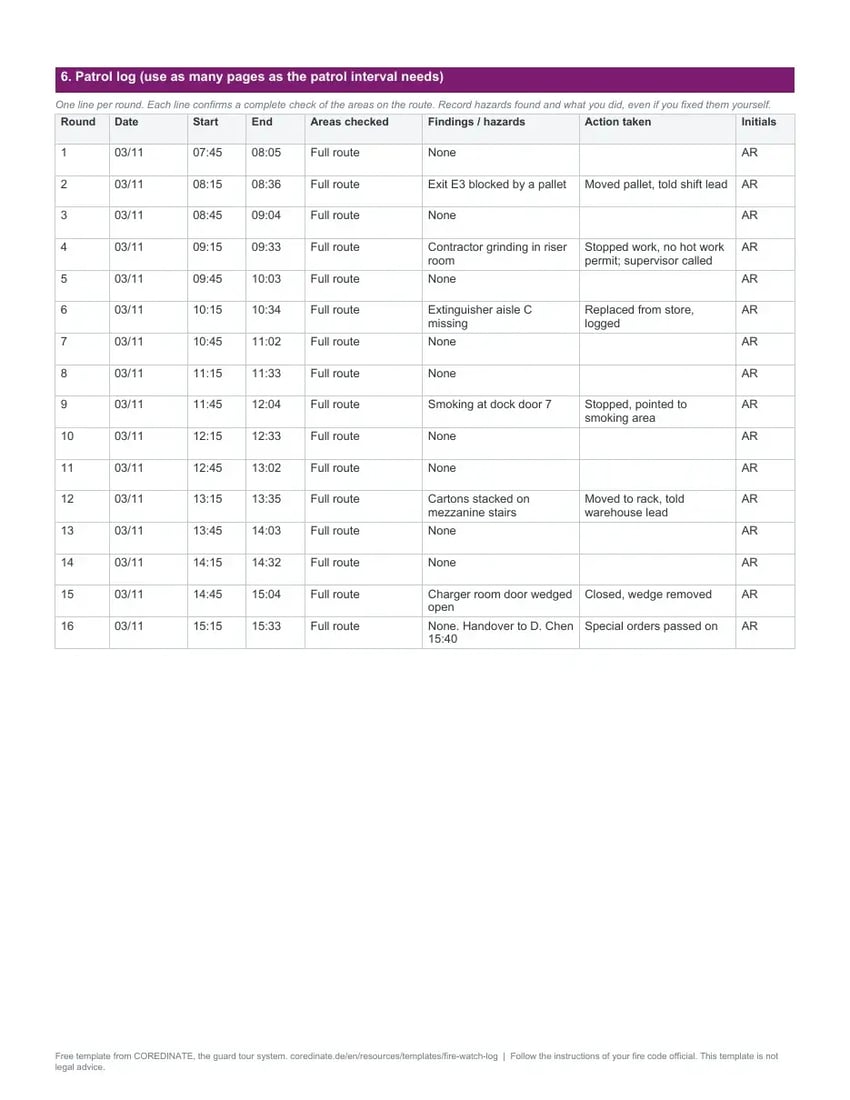
The example is a fictional warehouse with one sprinkler riser shut for a valve replacement. Round 4 shows what an entry looks like when the watch finds a contractor grinding without a hot work permit: the finding, the action and who was called, in one line.
Fire watch rounds in a guard tour system
On paper, a fire watch log proves that somebody wrote down a time. It does not prove the officer was in the riser room at 03:15. That is the gap a guard tour system closes.
With COREDINATE, the guard tour system, each area on the fire watch route gets an NFC checkpoint. The officer scans it with a smartphone, and every checkpoint scan reaches the portal in real time with its timestamp. Without a connection, the app stores scans and sends them later. Tour monitoring shows which checkpoints of the current round are still open, so a supervisor sees a missed round while the fire watch is still running, not the next morning.
Checks such as "exit E3 clear" become tasks tied to a checkpoint: the officer must answer done or not done, with a reason if not. Hazards go in as incidents with photos. At the end, the tour report lists every scan by time as a PDF for the building owner or the fire marshal.
Whether a fire code official accepts an electronic record in place of the paper log book is their decision. Ask before the first fire watch; until then, print the tour report and file it with the log.
Frequently asked questions
What is a fire watch log?
The record of a fire watch: the address and area under watch, the people on duty, the start and end time of every patrol, the areas checked, hazards found and what was done about them. It stays on site and must be available to the fire department or fire code official on request.
How often does a fire watch have to patrol?
As often as the fire code official orders. The guidance we read sets at least once an hour (CAL FIRE San Luis Obispo, California HCAI for health facilities), 30 minutes for factory and storage buildings and continuous patrols where people sleep or cannot leave on their own (Carroll County, Georgia). Ask for the interval in writing.
Can a security guard do a fire watch?
Yes, if the fire code official accepts the person as qualified. CAL FIRE San Luis Obispo states that a professional security company is not required and the building owner provides the personnel. Under IFC 901.7, whoever stands the fire watch has no other duty while on watch.
How long should a fire watch log be kept?
None of the fire department documents we read sets a retention period. California HCAI wants a copy of the log for each 24-hour period and Carroll County, Georgia wants the logs emailed daily under its acknowledgement form. Keep the original with the building's fire protection and impairment records.
Who can end a fire watch?
The authority that ordered it. California HCAI requires a written termination and does not accept a verbal one. Carroll County, Georgia ends a fire watch after a contractor confirms the repair in writing or an inspection confirms the system works.
Turn every fire watch round into a timestamped scan
Order a free test kit and try checkpoint scans, tour monitoring and tour reports in COREDINATE's guard tour app for 14 days.
More security templates
All security templates →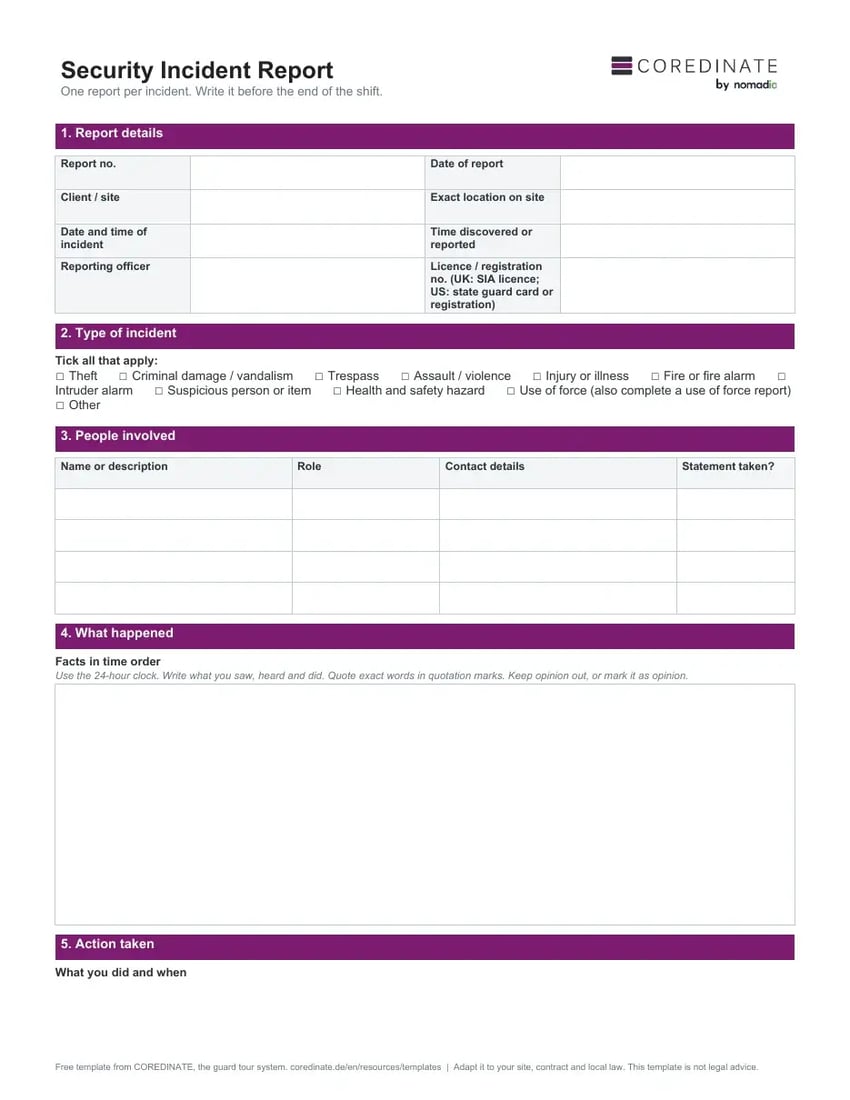
Sources
- California HCAI, Code Application Notice CAN 9-901.7 Fire Watch (effective 06/11/2025)
- Carroll County Fire Rescue, Fire Marshal's Office (Georgia): Fire Watch Requirements
- CAL FIRE / San Luis Obispo County Fire Department: Fire Watch
- City of Gaffney Fire Department (South Carolina): Fire Watch, quoting the 2021 International Fire Code
- OSHA 29 CFR 1910.252, Welding, cutting and brazing: general requirements
International Fire Code and NFPA texts are copyrighted. This page quotes them only where a public body reproduces them. Not legal advice.