Security templates/Workplace violence prevention plan/Violent incident log
Violent incident log template
California Labor Code 6401.9(d) requires employers to record every workplace violence incident in a violent incident log, leave out anything that identifies the people involved and keep each entry for five years. This free template has every field the statute lists, plus a filled-in example from a night shift at a truck gate.
Free, no sign-up. Two pages per entry plus a filled-in example. The full plan template includes the same log as an appendix: workplace violence prevention plan. Not legal advice.
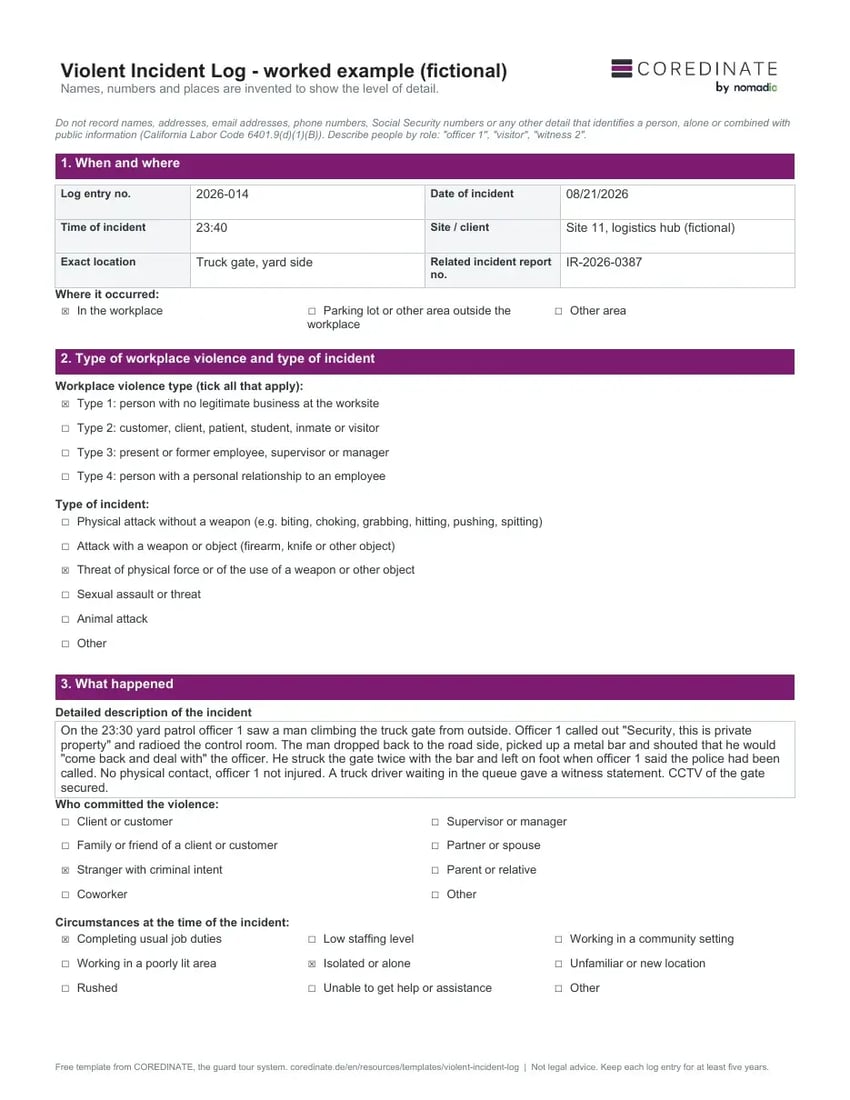
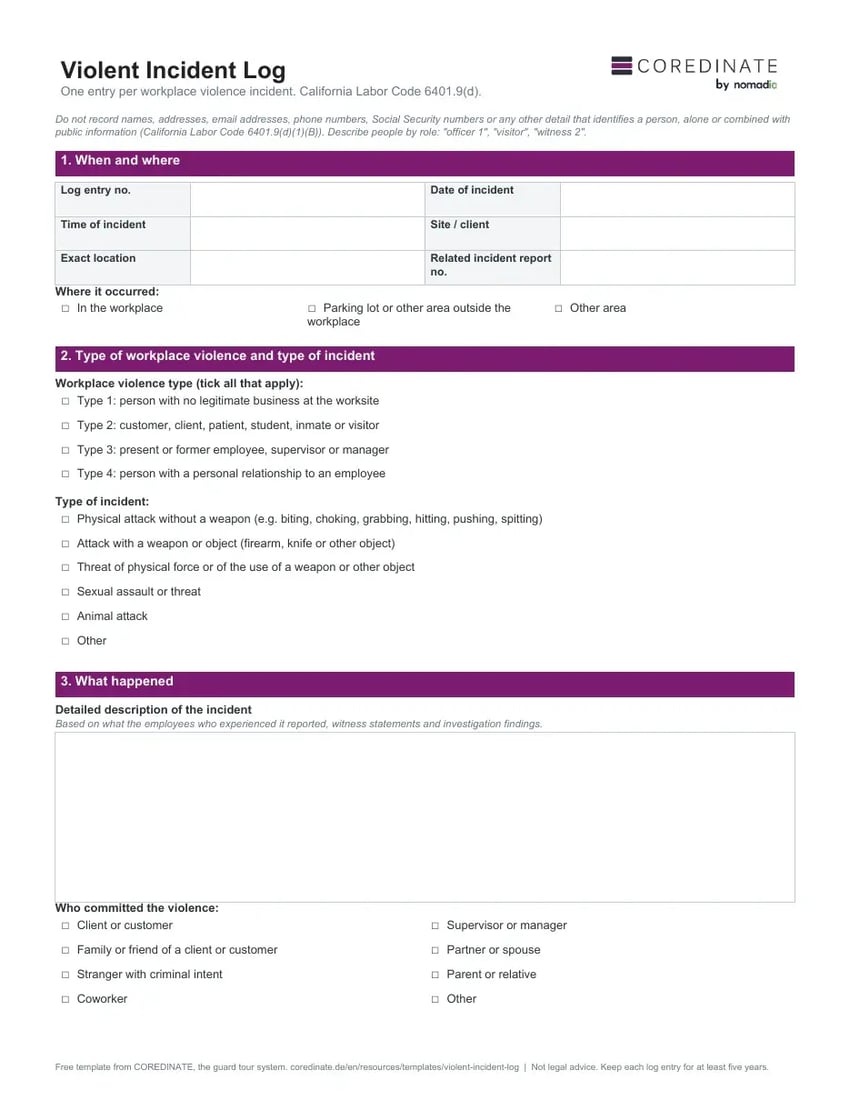
Every field the law requires
Subdivision (d)(2) lists nine pieces of information. The log entry has to be based on what the employees who experienced the violence said, on witness statements and on the investigation, so it is rarely finished on the night.
| Field | What to record | Example from the template |
|---|---|---|
| (A) Date, time, location | When and exactly where | 08/21, 23:40, truck gate, yard side |
| (B) Workplace violence type | Type 1, 2, 3 or 4; more than one is possible | Type 1: no legitimate business at the site |
| (C) Detailed description | What happened, in order, with roles instead of names | Man climbing the gate, threat with a metal bar |
| (D) Who committed it | Client or customer, their family or friend, stranger with criminal intent, coworker, supervisor or manager, partner or spouse, parent or relative, other | Stranger with criminal intent |
| (E) Circumstances | Usual duties, poor lighting, rushed, low staffing, isolated or alone, no help available, community setting, unfamiliar location | Usual duties; isolated or alone |
| (F) Where | Workplace, parking lot or other area outside, other area | In the workplace |
| (G) Type of incident | Attack without weapon, attack with weapon or object, threat, sexual assault or threat, animal attack, other | Threat of force with an object |
| (H) Consequences | Was security or law enforcement contacted and how did they respond; what was done to protect employees | 911 called, police attended; second officer posted for 7 nights |
| (I) Person completing the log | Name, job title, date | Field supervisor, next day |
What counts as workplace violence
Any act of violence or threat of violence at a place of employment. The statute sorts it into four types by who commits it; the security examples are ours.
Type 1
No legitimate business at the site
Includes anyone who enters or approaches workers to commit a crime.
At a postAn intruder threatens the officer who challenges him.
Type 2
Customers, clients, patients, students, inmates, visitors
Violence directed at employees by the people they serve.
At a postA shopper refused entry spits at the door officer.
Type 3
Present or former employee, supervisor, manager
Violence from inside the organization.
At a postA dismissed officer returns and threatens the shift lead.
Type 4
Personal relationship with an employee
Someone who does not work there but has a personal tie to an employee.
At a postAn officer's former partner turns up at the gatehouse.
Record it even when nobody is hurt: a threat with a weapon or an object counts regardless of injury. Intent does not decide it either. In its FAQ, Cal/OSHA says bites and scratches by special education students go in the log although they are unintentional.
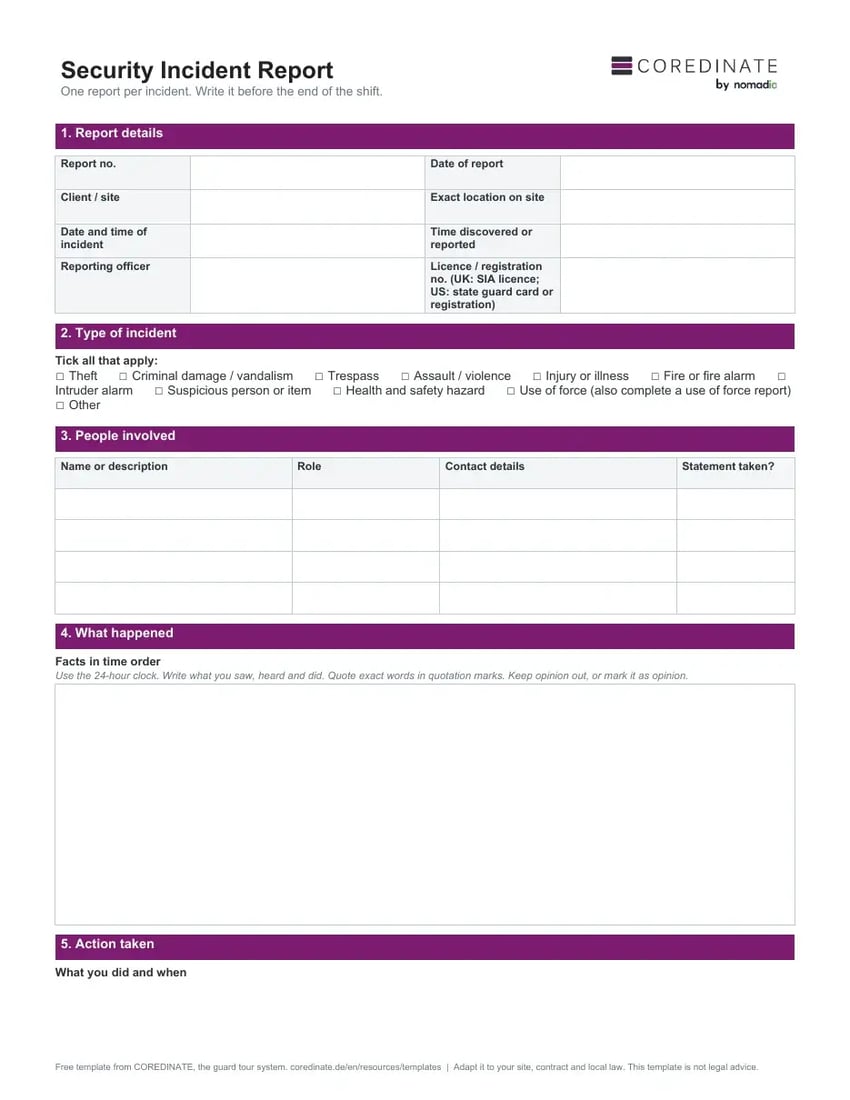
Incident report or violent incident log: keep both
Security companies already write an incident report for every event. The violent incident log does not replace it. The two records have different readers and different rules.
| Incident report | Violent incident log | |
|---|---|---|
| Purpose | Evidence for the client, police and insurer | Data for the plan: hazards, patterns, corrective action |
| Names | Yes: officer, license number, witnesses, suspect description | No: nothing that identifies any person involved |
| When | Before the end of the shift | After statements and the investigation |
| Who sees it | Client, police, insurer as agreed | Employees and representatives on request, Cal/OSHA, controlling employer |
| Keep for | As agreed with the client and insurer | At least five years |
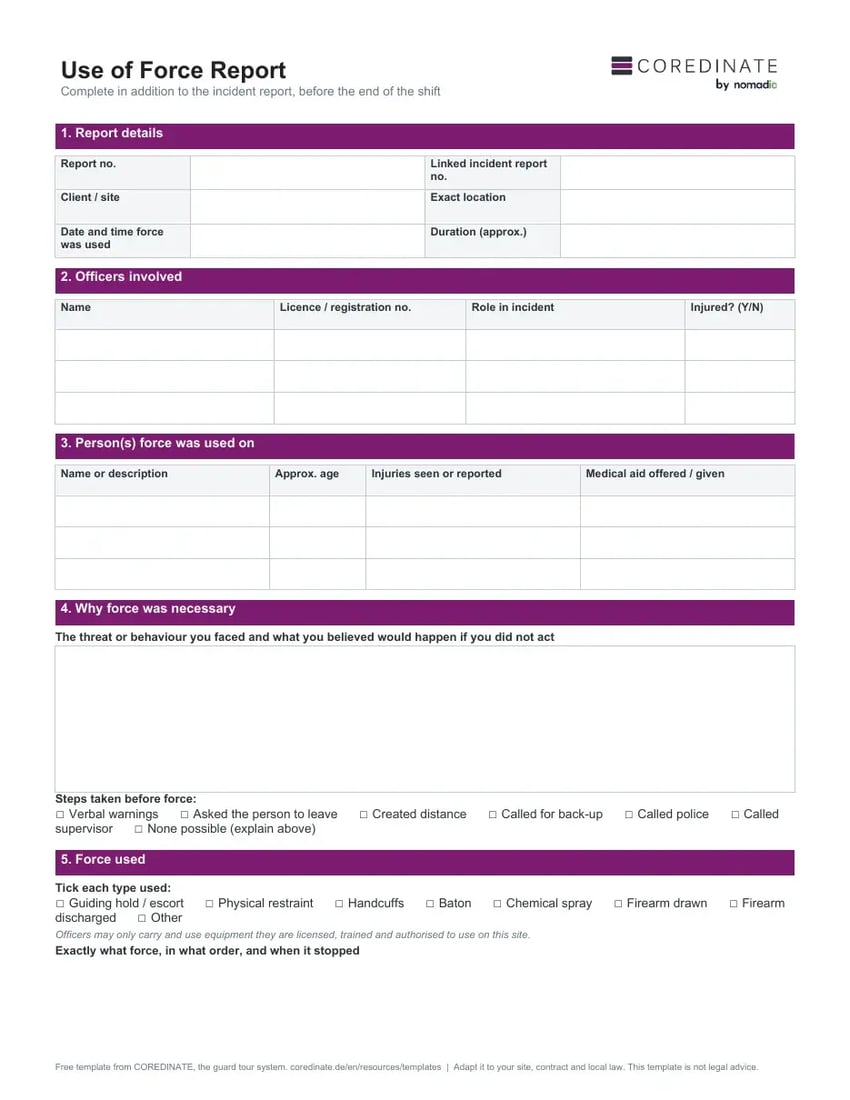
Write the incident report first with our security incident report template, then build the log entry from it and give the log entry the report number. That way the two records can be matched without names in the log.
Describing an incident without identifying anyone
The log must omit "any element of personal identifying information sufficient to allow identification of any person involved": names, addresses, email addresses, phone numbers, Social Security numbers, and anything that reveals identity alone or combined with public information ((d)(1)(B)). That last clause is the hard one. On a small site, "the female officer on nights" can identify someone as clearly as a name.
Describe people by role and number, and leave out details a coworker could match to a person. From the example in the download:
On the 23:30 yard patrol officer 1 saw a man climbing the truck gate from outside. Officer 1 called out "Security, this is private property" and radioed the control room. The man dropped back to the road side, picked up a metal bar and shouted that he would "come back and deal with" the officer. He struck the gate twice with the bar and left on foot when officer 1 said the police had been called. No physical contact, officer 1 not injured.
The officer's name, license number and shift details stay in the incident report, which the log references by number. Our reading is that vehicle plates, badge numbers and photos of faces also belong in the report and not in the log.
From the incident to the plan review
- On the shiftThe officer reports by radio or app; the incident report is written before the shift ends.Incident report number
- InvestigationStatements from the employees who experienced it and from witnesses, CCTV, findings.Log fields (A) to (H)
- Log entryThe person completing the log adds name, job title and date.Field (I)
- Multiemployer siteA copy of the log goes to the controlling employer, usually the client.Date and recipient
- On requestEmployees and their representatives can examine and copy it, without cost, within 15 calendar days.Request date, date sent
- Plan reviewThe log is reviewed at every review of the plan: annually, after incidents, on deficiencies.Plan section 11
Incident data from the post, not from memory
The log is only as good as the first report. If the officer writes it up two days later, times and words are gone. In COREDINATE, the guard tour system, officers log an incident in the app with photos while it is happening, and it reaches the portal straight away. Incident types carry an impact level, so threats and assaults can be filtered for the plan review, and notification rules can email the supervisor who completes the log.
The de-identified log entry itself is written by a person, from that report. That step stays with you.
Frequently asked questions
What has to be in a violent incident log?
Date, time and location; the workplace violence type; a detailed description; who committed the violence; the circumstances; where it happened; the type of incident; the consequences, including whether security or law enforcement was contacted; and the name, job title and date of the person completing the log (6401.9(d)(2)).
Can we design our own violent incident log?
Yes. Cal/OSHA's FAQ says employers may develop their own log as long as it records the information listed in 6401.9(d)(2). This template follows that list field by field.
Do threats without injury go in the log?
Yes. Workplace violence includes threats of violence and the threat or use of force that has a high likelihood of injury, psychological trauma or stress, whether or not anyone is injured. Lawful self-defense or defense of others is not workplace violence.
Does an incident go in the log and on the Cal/OSHA Form 300?
Every workplace violence incident goes in the log. It also goes on the Form 300 if it meets the recording criteria, for example medical treatment beyond first aid or days away from work, according to Cal/OSHA's FAQ.
How long do we keep the violent incident log?
At least five years (6401.9(f)(3)). On request, it must be available to employees and their representatives for examination and copying, without cost, within 15 calendar days.
Capture the incident on the shift it happens
Order a free test kit and try incident logging with photos and notification rules in COREDINATE's guard tour app for 14 days.
More security templates
All security templates →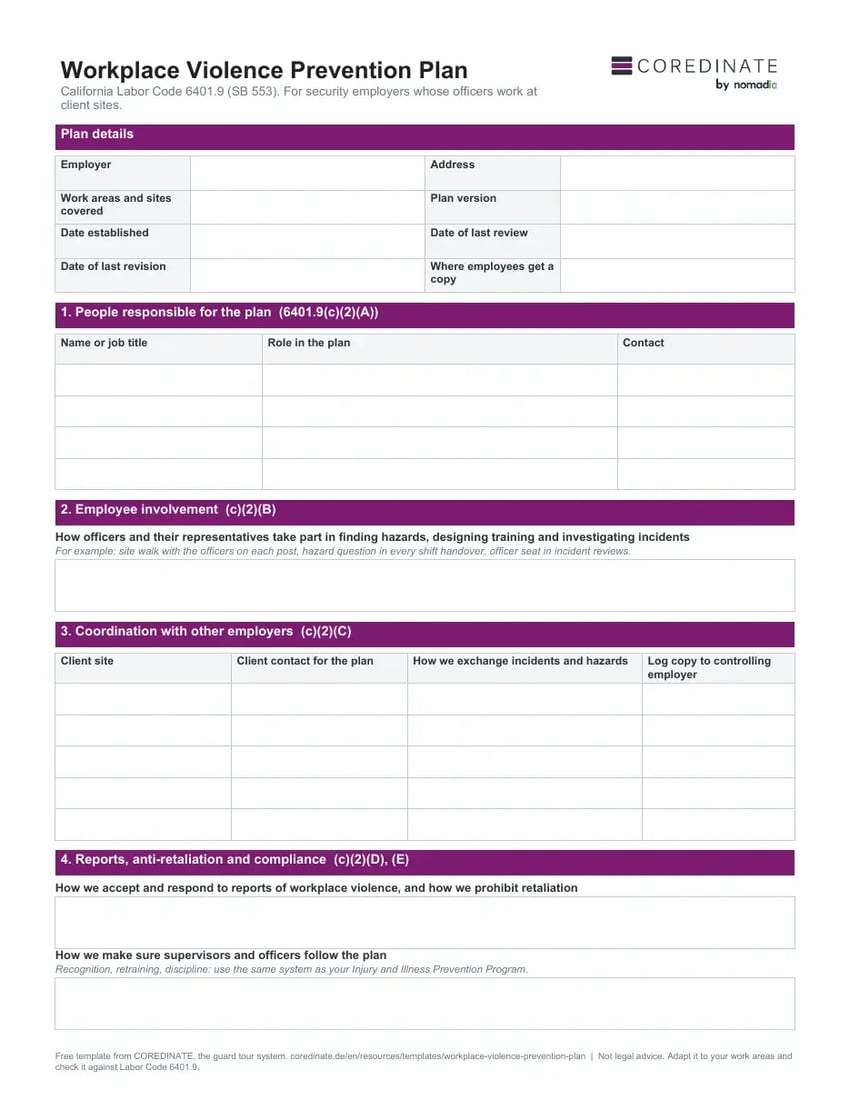
Sources
- California Labor Code section 6401.9, subdivisions (a), (d) and (f)
- Cal/OSHA, Frequently Asked Questions about Workplace Violence Prevention in General Industry
- Cal/OSHA, Workplace Violence Prevention for General Industry (Non-Health Care Settings)
Read 19.11.2026. Health care facilities under title 8 section 3342 keep a log under that section instead. Not legal advice.